

Current News
Many Rail Fares in Bergen County to Go Up on March 1st:
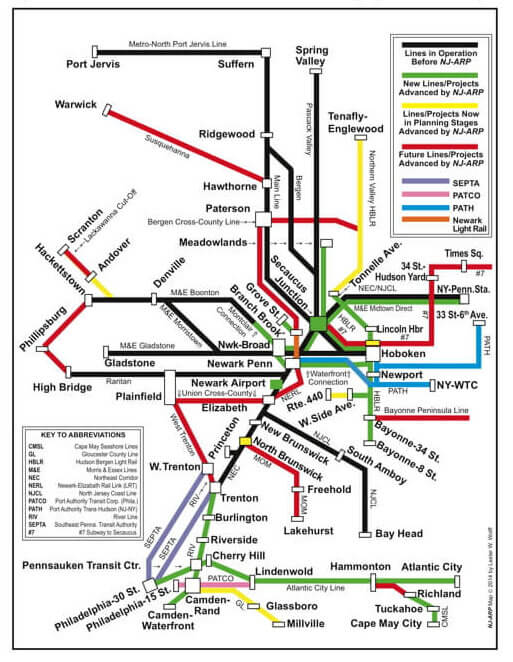
New Jersey Transit will increase its railroad fares to and from Hoboken and New York City at several stations in northern and western Bergen County (as well as to and from Suffern, New York) on March 1, 2013. These NJT fare increases are occasioned by the Metro-North Railroad raising its fares on the same date to and from stations between Sloatsburg and Port Jervis, New York on the former Erie Railroad's Main Line and Graham Freight Line, as well as between Pearl River and Spring Valley, New York on the Pascack Valley Line.
As NJ-ARP members are aware, New Jersey Transit operates the Metro-North Railroad's Port Jervis Line and the northern end of the Pascack Valley Line on behalf of Metro-North under an agreement under which MNR contributes locomotives and coaches to NJT's rolling stock pool and pays NJT for operating trains serving stations located in New York State (including those that run express within New Jersey). Fares to and from MNR's stations are set by the Metropolitan Transportation Authority, with credit being given by NJT to MNR for all revenue generated.
In a statement posted on NJT's website stated "At times when NJ TRANSIT fares would otherwise be higher than Metro-North fares, an automatic agreement is triggered that 'holds down' NJ TRANSIT fares, with Metro-North reimbursing NJ TRANSIT for the difference. On March 1, 2013, Metro-North fares will increase, automatically triggering an adjustment to NJ TRANSIT fares at stations where a 'hold down' has been in effect."
This statement did not, however, explain the logic behind the 'hold down.' If NJT's fares from and to stations on its Bergen County Line, Main Line and Pascack Valley Line were less than those to points in New York State, many passengers who use those stations - alert to the difference - would opt to purchase tickets valid for use from and to MNR's stations. It would be very difficult, if not virtually impossible, for NJT to counter this practice. As a result, the revenue involved would be credited to Metro-North rather than to New Jersey Transit.
The stations where all fares will be increased are Allendale through Suffern on the Main Line and Westwood through Montvale on the Pascack Valley Line. Only 10-Trip and Off-Peak Round Trip fares will be increased at Ho-Ho-Kus and Waldwick on the Main Line and at Emerson on the Packack Valley Line. In addition, Off-Peak Round Trip fares will be increased at the Glen Rock stations of the Bergen County Line and the Main Line, at Ridgewood on the Main Line, and at Oradell on the Pascack Valley Line.
As examples, Metro-North's current one-way fare from Sloatsburg and Tuxedo to New York is $12.25, an off-peak round trip ticket is $19.75, and a monthly ticket is $330.00. Under the 'hold down' agreement, NJT's current fares to Mahwah and Suffern are the same. Come March 1st, when Metro-North's fares from Sloatsburg and Tuxedo to New York will be increased to $13.00 one-way, $21.00 for an off-peak round trip ticket, and $353.00 for a monthly ticket, NJT will increase its fares at Mahwah and Suffern to the same amounts. Similar percentage increases apply to senior/disabilities tickets, 10-trip tickets, weekly tickets, and student monthly passes.
Sharp minds may ask "What is this about off-peak round trip fares? Didn't NJT discontinue all of those tickets with its last round of fare increases? They are not on the matrices of Ticket Prices published en NJT's Main Line/Bergen County and Pascack Valley Line timetables/" Well, that of one of those things that NJT wants to keep hidden but they do exist because Metro-North insisted upon them. The proof can be found on NJT's website by clicking on Alerts & Advisories, next of Customer Notices, and then on Main, Bergen County & Pascack Valley Lines: Metro-North Fare Change Effective March 1, 2013 Will Also Affect Certain NJ TRANSIT Fares. But, if in doubt, do not waste time looking them up because this information is likely to dis appear at the end of this month.
New Jersey Transit's Ridership Trends in its 2nd Quarter Fiscal 2013 Year:
NJT's fiscal year begins on July 1st of a given year and extends through June 30th of the following calendar year. During the months of October, November and December 2012, New Jersey Transit experienced an overall ridership decrease of 6.4% on its entire system, -11.5% on its railroad lines, -3.3% on its bus lines, and -10.5% on its light rail lines compared to the same quarter in fiscal year 2012, i.e. in 2011.
As expected, these disappointing statistics were the result of the damage done to NJT's railroad and light rail system, both infrastructure and rolling stock, by Superstorm Sandy. Because service interruptions of this magnitude and duration were not experienced in the same quarter of 2011, meaningful comparisons on a qualitative basis cannot be made based on the quantitative data.
Ridership on NJT's eight railroad lines was reported to be at the following passenger volumes and percentage increases or decreases during the three-month period overall and on Weekdays, Saturdays and Sundays:
For NJ Transit's three light rail operations, the comparable statistics are:
Unfortunately, given the devastation that Superstorm Sandy caused to the infrastructure and rolling stock of NJT's railroad and light rail transit lines, and the fact that railroad service - considering both the number of trains being run currently and their length (number of cars) is still less than that provided before the storm hit - the 3rd Quarter (January through March 2013) of NJT's 2013 Fiscal Year also is unlikely to be encouraging.
Dispute in Montreal Over ALP-45DP Locomotives:
Agency Metropolitan de Transport, (AMT) the operator of commuter rail and express bus services in the Greater Montreal Region, and the Canadian National Railway (CN) are involved in an increasingly accusatory dispute over CN's refusal to allow AMT's 20 ALP-45DP locomotives on its trackage. These locomotives, built in Germany by Bombardier at a cost of C$308 million (C$15.4 million apiece), are virtually identical to the 35 dual powered locomotives acquired by New Jersey Transit from the same builder in what amounted to a joint order.
The dispute relates to a derailment on December 7, 2011 that occurred as an AMT train of Multilevel coaches from Mont St. Hilaire pulled by an ALP-45DP locomotive was pulling into Montreal's Gare Central (Central Station to English speakers). The derailment occurred whlile the train was operating at a low speed and none of the 1,400 passengers were injured.
Following the derailment, in addition to repairing the damaged track, CN upgraded the condition of its tracks at Central Station, and increased the frequency of visual track inspections at that location from once monthly to weekly. AMT modified its ALP-45DP locomotives to reduce the forces exerted by their trucks on the tracks.
Nevertheless, all of AMT's ALP-45DP were placed in storage pending an investigation by the Transportation Safety Board of Canada. The TSBC, in a 30-page report, found that the "heavier locomotive, combined with existing track conditions, caused the track to widen." In other words, CN's track maintenance was primarily at fault. The TSBC also said that all required track inspections had been performed and the locomotives met industry and regulatory norms.
AMT's Chief Executive Officer, Nicholas Girard, revealing his frustration with CN, said "The independent TSB report clearly says that the primary cause was the quality of the tracks and the derailment wouldn't have happened if the tracks were in a better state. For the past ten years, CN has allowed on its network Amtrak and Via Rail locomotives of comparable force on its tracks. So why won't they allow publicly-funded AMT locomotives?" Of course, both Amtrak and Via Rail locomotives also are publicly funded although not with money provided by the Government of Quebec sources.
CN's spokesman responded that it is "rigorously evaluating all the relevant analysis into this complicated technical issue, including the TSB findings. There are additional targeted improvements to track infrastructure that are going to be required to safety operate that new equippment" on CN tracks. He added that "CN wants to work with AMT to determine what those improvements will be, how much they will cost, and who will pay for them."
Meanwhile, the Canadian Pacific Railway (CP) allowed AMT to begin using ALP-45DP locomotives and Multilevel coaches on its Blainville Line on November 28, 2012. As of this writing, four of them are on service on commuter rail lines serving Terminus Lucien-Allier that are operated by CP and are not experiencing any derailments.
It had been AMT's intention to begin operating its ALP-45DP locomotives, along with Multilevel coaches (again virtually identical to those of NJT) on its Deux Montagne's Line, which is electrified at 25 kV 60 Hz AC and runs through the 5 kilometres-long (3.1 miles-long) Mount Royal Tunnel. Peak period trains on this line suffer from severe overcrowding, often with as many as 1,800 passengers onboard single-level trains of electric multiple-unit cars having only 900 seats.
AMT also intends to use the dual powered locomotives on its Train de l'Est, a C$671 million project scheduled to open in Spring 2014. Trains running on this 51 kilometers-long (about 32 miles-long) line will use Central Station and the Mount Royal Tunnel for 9 kilometers to an existing junction on the electrified Deux Montagne's Line located north of its Mount Royal station. At this point, named Train de l'Est will divert to the CN's currently freight-only Saint Laurent Subdivision and run northeast for 30 kilometers through Montreal-Nord as far as Repentigny, a suburb located on the north shore of the Saint Lawrence River;
it will then turn 180 degrees and head northwest to Terrebonne, running in the median of Autoroute 640 for 6 kilometers, after which it will follow the Chemin de Fer Quebec-Gatineau (Quebec-Gatineau Railway), a former CP line, northeast again to reach its terminus at Mascouche, involving 12kkilometres of new track. Between 1946 and 1968, CN's line was electrified as far east as Montreal-Nord with electric locomotive-hauled trains making one round trip to and from Montreal's Central Station; this service was discontinued after Montreal's then new rubber-tired metro drained away most of its ridership. In a sense, although AMT'a ALP-45DP locomotives will run in diesel mode for most of their route, Train de l'Est will be a "Back to the Future and Beyond" experience for the Greater Montreal Region.
New Jersey Transit currently is operating some of its ALP-45DP locomotives in weekday service between Gladstone and Hoboken. They are running in electric mode west of Newark Broad Street and in diesel mode from there to and from Hoboken because the Morris & Essex Line catenary cannot be energized east of Kearny due to damage caused by Superstorm Sandy's tidal surge to the traction power substation located in Hoboken. Prior to the hurricane, they also were being used on several Morris & Essex and Montclair-Boonton Line trains that originate or terminate west of Dover, as well as between Bay Street (Montclair) and Hoboken on weekends and major holidays.
ALP-45DPs also were observed at times on the Main Line, Bergen County and Pascack Valley Lines. Amtrak has not, however, approved these locomotives for us on its Northeast Corridor Line to Penn Station, New York, which at this time precludes them from being operated on Midtown Direct trains of the Morris & Essex Line and the electrified portion of the Montclair-Boonton Line, as well as planned through trains from the non-electrified Raritan Valley Line and the non-electrified portions of the Montclair-Boonton Line and the North Jersey Coast Line.
Weekday Train Service Increased on Utah's Front Runner:
The Utah Transit Authority (UTA), operator of an extensive bus network and three light rail transit lines known as TRAX, will add several weekday trips to its Front Runner commuter rail line connecting Ogden, Salt Lake City and Provo on February 19th. With the addition of four southbound and three northbound trains on Mondays through Fridays, there will be 28 trains in each direction between Ogden and Salt Lake City and 27 trains in each direction between Provo and Salt Lake City, of which 22 trains in each direction will run through from Ogden to Provo or vice versa - a distance of 82 miles. Four of the southbound trains and three of the northbound trains will originate or terminate, respectively, their trips at Pleasant View, located 6 miles north of Ogden.
The northern section of Front Runner, 38 miles between Salt Lake Central Station and the Ogden Transit Center, over trackage owned by UTA was opened on April 26, 2008.
An additional 6 miles from the Ogden Transit Center to Pleasant View, was opened on September 29, 2008 using Union Pacific Railroad (UP) trackage upon which UP allows UTA to operate only very limited Front Runner service. The southern section of Front Runner, extending for 44 miles from Salt Lake Central Station to Provo, was opened on December 10, 2012. The capital investment in the Front Runner, including federal grants, is approximately $850 million for construction of the 88 miles-long line and purchase of its fleet of 21 diesel-electric locomotives and 45 coaches, 20 of which are Bombardier-built "Go Transit" type double-deckers and 25 are ex-New Jersey Transit Comet I cars, built in 1971-73 by Pullman-Standard and handsomely refurbished by Bombardier.
The new schedules, however, will reflect running times that have been lengthened to increase the reliability of the FrontRunner (so named because it parallels the Wasatch Front, a mountain range east of the Great Salt Lake) and protect timed-transfer connections with buses at the line's stations. UTA's spokesman stated that, while the train service between Ogden and Salt Lake City had been working reasonably well, problems arose after the commuter rail line was extended to Provo. "When we started Front Runner South in December, we struggled to meet the printed schedule. It was too tight."
Under the new schedules, half-hourly headway will be operated departing southbound from the Ogden Transit Center to Salt Lake Central Station between 5:09 AM and 10:09 AM and again between 4:09 PM and 6:09 PM, with hourly departures being run in between and between 6:09 PM and 11:09 PM. From Salt Lake Central Station to Provo, half-hourly headways will be operated from 5:11 AM to 9:11 AM and again from 3:11 PM to 7:11 PM,
with hourly departures being run in between and from 7:11 PM and 11:11 PM. Northbound from Provo to Salt Lake Central Station, half-hourly headways will be operated from 4:50 AM and 9:50 AM and again from 3:50 PM to 7:50 PM, with hourly headways being run in between and from 7:50 PM to 8:50 PM with a last train at 10:20 PM. From Salt Lake Central Station, northbound trains to the Ogden Transit Center will operate on half-hour headways from 5:57 AM to 8:57 AM and from 2:57 PM to 6:57 PM, with hourly headways being run in between and from 6:57 PM to 9:57 PM with a last train (running through from Provo) at 11:27 PM. In addition, there will be a departure from Woods Cross (two stations north of Salt Lake Central Station) for the Ogden Transit Center and Pleasant View at 3:44 AM and two departures from North Temple Front Runner (one station north of Salt Lake Central Station) for the Ogden Transit Center at 4:32 AM and 5:32 PM.
The Front Runner also operates on Saturdays, during which 90 minute headway are operated with most trains running through from the Ogden Transit Center via Salt Lake Central Station to Provo or vice versa. The first and last southbound departures from the Ogden to Salt Lake Central Station will depart at 8:16 AM and 12:46 AM, respectively. From Salt Lake Central Station to Provo, the first and last trains will depart at 6:07 AM and 12:07 AM, respectively. Northbound from Provo to Salt Lake Central Station, the first and last trains will depart at 7:27 AM and 1:13 AM, respectively. From Salt Lake Central Station to the Ogden Transit Center, the first and last trains will depart at 6:55 AM and 11:25 PM, respectively.
No Front Runner service is operated on Sundays at the present time nor will it be under the new schedules. Perhaps this will change, as it did for the TRAX light rail transit lines, as ridership on weekdays and Saturdays builds up.
In contrast with New Jersey Transit's practices, it is apparent that the Utah Transit Authority understands the importance and value to its passengers of even interval, clock-face train schedules, as well as minimizing scheduled non-revenue train movements by opening what otherwise would be "light trains" to the public, thereby adding to the convenience of the service on offer and most assuredly earning some marginal revenue.
Coming Events
Next NJ-ARP Board Meeting on March 16, 2013: The next meeting of the NJ-ARP Board of Directors has been scheduled for Saturday, March 16, 2013 to be held at Raritan Bay Coffee Company's cafe located in NJT's Perth Amboy railroad station. The location and timing will be posted on our website as soon as details are firmed up. All currently-paid up members will be welcome to attend and participate in the board's discussions. Those wishing to attend meetings are requested to please e-mail NJ-ARP at njarp@nj-arp,org at least three (3) weekdays prior to the meeting, leaving your name and phone number so that we can notify the venue as to how many members are attending.