

Current News
Repairs to Rolling Stock Damaged by Superstorm Sandy Approved: New Jersey Transit’s Board of Directors approved two sole-source contracts for repairs to locomotives and coaches damaged last October during Superstorm Sandy at a “Special Telephone Meeting" held on March 4, 2013. The contract awards are to:
The 308 Multilevel wheel-and-axle assemblies, the equivalent of 77 car sets, will be shipped by ORX to Bombardier as owner-supplied equipment, thereby reducing the cost to NJT of repairing the Multilevel cars.
In addition, NJT’s Board approved adding a $1 million to an existing contract with Hall Construction of Farmingdale, New Jersey for remediation of flood damage of the historic Hoboken Terminal, including vendor space, the main waiting room, and public restrooms, bringing the total contract value to $31,948,750.
ALP-45DP Locomotives Ran to New York Penn Station:
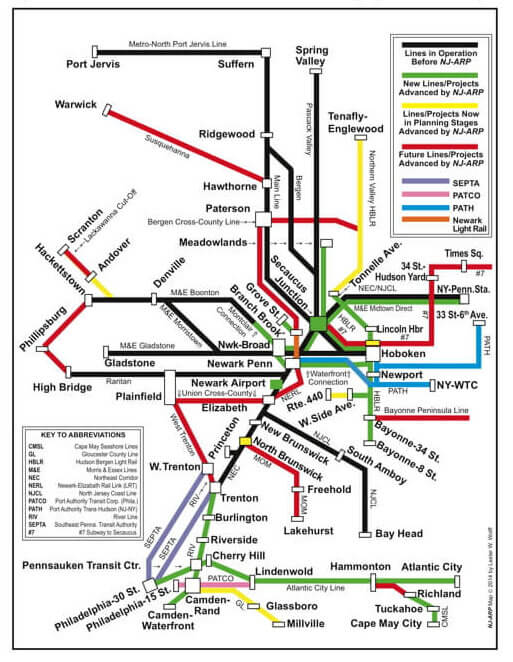
New Jersey Transit (NJT) used several of its ALP-45DP locomotives to operate the Midtown Direct service of its Morris & Essex Line on Saturday and Sunday, March 2nd and 3rd. Because of work on high voltage transmission lines that follow the railroad west of Summit, the M&E’s catenary was de-energized for the weekend. The NJT’s hourly Midtown Direct trains between Dover and New York’s Penn Station were propelled by dual-powered locomotives, instead of ALP-46 electric locomotives, with Amtrak concurring with their being operated for the first time on its former Pennsylvania Railroad “High Line” and through the North River Tunnels.
NJ-ARP Director Jishnu Mukerji rode the Midtown Direct service on this past Saturday; his first-hand observations can be read by Click Here which leads to our Transit News web page.
Agreement for Construction of First Piece of Amtrak’s Gateway Project:
Amtrak and Related Properties, the developer of the Hudson Yards Project being constructed above the Long Island Rail Road’s West Side Storage Yard, have reached an agreement covering construction of an 800 feet-long “box tunnel” required for Amtrak’s Gateway Project. Related Properties is in the early stages of building a deck over the 26-acre site that will contain, among other structures, a 900-f00t tall office tower that will be the future home of Coach, Inc. If suitable provisions were not made at this time, it would not be possible for the Hudson River tunnels specified in Amtrak's proposed Gateway Project to be built on an alignment that would connect the new tubes to the existing New York Penn Station and – if built – the Moynihan Station Project.
New York’s senior US Senator, Charles Schumer, worked with US Secretary of Transportation Raymond LaHood to arrange for Amtrak to receive an estimated $120-to-150 million in “mitigation” funds from the $60.4 billion post-Sandy aid package to pay for construction of the new tunnel structure. When this financial arrangement was announced, Amtrak’s President, Joseph Boardman, said “Amtrak is actively working will all parties at Hudson Yards to secure the only viable alignment for a future trans-Hudson rail tunnel connecting directly to Penn Station as part of the proposed Gateway program. Federal funding is essential for preservation of this tunnel right-of-way through the area of the Hudson Yards development project. We are committed to ensuring that Penn Station can meet the needs of the northeast region for the decades ahead.”
The master plan for the Hudson Yards Project includes six million square feet of commercial office space, a 750,000 square-foot retail center with two levels of restaurants, cafes, markets and bars, a five-star hotel, approximately 5,000 residential apartments, a 750-seat school, and 14 acres of public space. This real estate development is the main reason why the Bloomberg Administration of the City of New York and the Metropolitan Transportation Authority have pressed ahead with extending the No. 7 Times Square - Main Street, Flushing subway line west and then south to 34th Street and Eleventh Avenue.
$400K Grant to Study Additional Light Rail Station near the Jersey City/Hoboken Boundary:
New Jersey Transit has received a $400,000 grant to study adding a station to the Hudson-Bergen Light Rail (HBLR) system at 18th Street and Jersey Avenue in Jersey City, close to the Jersey City/Hoboken boundary at the southwestern edge of Hoboken. US Senators Frank Lautenberg and Robert Menendez were joined by Jersey City Mayor Jerramiah Healy and Hoboken Mayor Dawn Zimmer at the Second Street Station of HBLR when the grant was announced. Mayor Zimmer also requested that the study look into ways of reducing traffic congestion adjacent to the Second Street Station where Hoboken’s Paterson Avenue, which becomes Paterson Plank Road in Jersey City, crosses the HBLR tracks.
18th Street and Jersey Avenue, Jersey City are in located in a rather desolate area south of the New Jersey Transit Rail Operations’ approach from the former Lackawanna Railroad’s Bergen Tunnels to the historic Hoboken Terminal. In this area, HBLR turns east from the right-of-way of the abandoned Belt Line 13 freight line, last used by CSX in the 1990s, and rises up a steep grade to pass over Jersey Avenue before proceeding towards the triangular junction used by light rail trains en route to and from Hoboken and Exchange Place and points south. It would appear that Jersey City’s interest in adding an HBLR station at this location is to encourage real estate developments on this fallow land.
Central Florida’s Sun Rail Project Receives Additional Federal Funds:
Peter Rogoff, the head of the Federal Transit Administration (FTA), announced that the Florida Department of Transportation (FDOT) will receive an additional $87.3 million in federal funding for its SunRail Project on February 25th, bringing the total allocation to date of Fiscal Year 2012 and prior year funds to $148.5 million. In July 2011, the FTA and FDOT entered into a Full Funding Grant Agreement (FFGA) committing $178.6 million in New Starts funds, representing 50 percent of the total project cost, to Phase 1 of the SunRail Project.
SunRail, previously known as the Central Florida Commuter Rail Project, is intended to be a 61.5 miles-long line built along CSX Transportation's “A Line” (former Atlantic Coast Line Railroad main line) centered on Orlando. Phase 1, with 12 stations, will extend for approximately 31 miles south from DeBary in Volusia County through Orlando to Sand Lake Road in Orange County. Construction for this portion of the project is well-advanced at this time, with revenue service expected to begin in 2014. Phase 2, with 5 additional stations, will add approximately 30 additional miles to SunRail by extending it north from DeBary to DeLand in Volusia County and south from Sand Lake Road to Poinciana in Osceola County; revenue service on this portion of the line is expected to begin in 2016.
FDOT has ordered seven 3,000 horsepower diesel-electric locomotives from MotivePower Industries and fourteen Bi-Level coaches, including nine cab cars, from Bombardier Transportation, with deliveries of both orders to commence in 2013. FDOT also has options for 13 additional locomotives and up to 46 additional Bi-Level coaches that it intends to exercise when FTA and it enter into a FFGA for Phase 2 of the SunRail Project, expected to occur later this year.
Alstom to Build 34 Low-Floor Light Rail Vehicles for Ottawa:
The Rideau Transit Group, the design-build-maintain consortium that has been awarded a C$2.1 billion (US$2.0 billion) contract by the City of Ottawa to construct Phase 1 of the Canadian capital’s light rail transit system, has entered into a C$533 million contract with Alstom to supply thirty-four 100 percent low-floor light rail vehicles (LRVs) for the system and maintain them for 30 years. Ottawa’s LRVs will be designed to cope with severe winter weather conditions and have four carbody sections, be 160.7 feet long (49 meters), be able to traverse a 82 feet (25 meters) radius curve with a full passenger load, and have a top speed of 65 mph (104.6 kph). They will seat 120 and stand up to 180 passengers and be air-conditioned. Alstom will construct these Citadis Spirit LRVs at its plant in Hornell, New York, with final assembly – including satisfying a 25 percent Canadian content requirement - taking place in Ottawa.
The first phase of Ottawa’s Confederation Line, as the light rail transit project has been named, will be eight miles long (12.5 kilometers) and have 13 stations. Approximately 1.55 miles (2.5 kilometers) of the line and three stations will be in subway through the downtown area. Significantly, almost all of the light rail transit line’s surface-level alignment will be built along the East-West Transitway, a bus rapid transit facility that has been found to be inadequate for Ottawa’s current and long-term transit needs. Future phases of the project also envision conversion of additional bus rapid transit alignments and stations into an expanded light rail transit system. The City of Ottawa expects construction of the project to be far enough advanced by 2017 to permit demonstration rides on a portion of the Confederation Line when Canada will celebrate its 150th anniversary as a nation; revenue service over its full length is planned for 2018, five years after the start of construction later this year.
Also of note is that the Confederation Line’s catenary will be energized at 1,500 Volts DC (as is Sound Transit’s LRT system in Seattle, Washington), which will reduce the number of traction power substations significantly compared to 750 Volts DC installations.
The C$533 million contract value for this order (C$15.68 million per car), including 30 years of maintenance by the carbuilder, makes the point very well that the real cost of a transit vehicle (as also is the case with a motor vehicle) is not the initial price paid to buy it but that of owning it over its full life expectancy. Along with winning this contract, the first of its type in North America, Alstom has a strong incentive to “get it right the first time” inasmuch as, in essence, it has agreed to offer a lifetime warranty.
In celebrating its winning this contract, Alstom announced that it intends to pursue other LRV orders in the United States based on production in Hornell while satisfying the 60 percent Buy America content required for federally-funded transit projects. No doubt Alstom can produce a version of the Citadis Spirit LRV with fewer and shorter carbody sections for customers who require LRVs approximately 90-to-125 feet-long, as well as with propulsion systems designed for 600 VDC or 750 VDC traction power supply.
New Jersey Transit owns 200 Comet V coaches built by Alstom in 2002-2004, as well as well as operating and maintaining 65 more owned by Metro-North Railroad. NJT also owns 33 PL42AC diesel-electric locomotives built by Alstom in 2005-2006. Perhaps, if NJT ever is able to move the proposed extension of the Hudson-Bergen Light Rail system to Englewood and/or Tenafly into construction, Alstom will bid a version of its Citadis Spirit LRVs for the additional cars that this long-waited project will require.
Coming Events
Next NJ-ARP Board Meeting on March 16, 2013: The next meeting of the NJ-ARP Board of Directors has been scheduled for Saturday, March 16, 2013, commencing at 10:00 AM, to be held at the Raritan Bay Coffee Company’s café located in NJT’s Perth Amboy railroad station. All currently-paid up members will be welcome to attend and participate in the Board’s discussions. If you wish to attend meetings are requested to please e-mail NJ-ARP at njarp@nj-arp.org by March 13, leaving your name and phone number so that we can notify the venue how many members will be attending.