

Current News
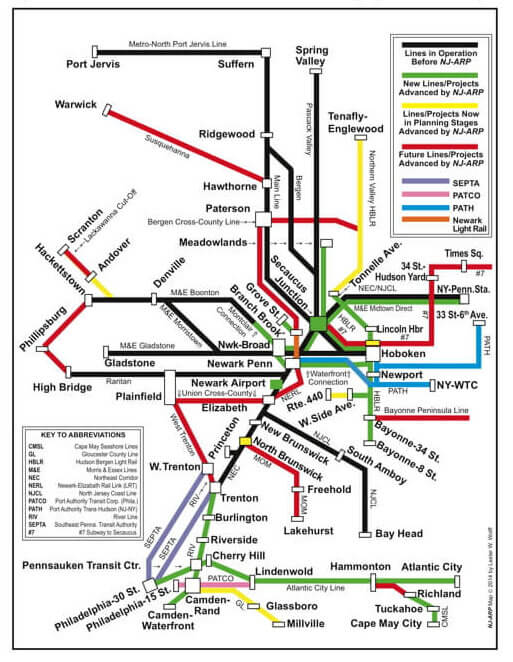
Free Parking on Weekends at Hudson Bergen Light Rail Stations: New Jersey Transit began offering free parking on Saturdays and Sundays at the following five stations on its Hudson Bergen Light Rail system on February 16th as part of a one-year program aimed at encouraging ridership on weekends:
In announcing this program at NJT’s Board Meeting held on Wednesday, February 13th, Executive Director James Weinstein said “Free parking on weekends is a great incentive for people to get out of their cars and hop on the light rail to explore. Customers will save more than just money – with convenient access to the waterfront and trans-Hudson connections, they’ll avoid traffic and save time as well.”
Mr. Weinstein credited Jack May, NJ-ARP’s Vice President, for suggesting the program to him, saying “We took a look at Jack’s suggestion and decided that potential for increased revenue from ticket sales would more than likely offset the minor loss in parking lot revenues.” Mr. Weinstein also stated that NJT will publicize the “Free Parking on Weekends at HBLR Stations” in the hope that the program will be a success and can be made permanent.
In addition to Jack, other NJ-ARP members including Frank Miklos, have long observed that there have been very few automobiles parked in these lots on weekends. Because of the “Permit Only” restrictions on parking spaces closest to the station entrances, Frank pointed out occasional users of HBLR had the longest walks to shelter – sometimes in inclement weather – while almost all of the spaces adjacent to the entrances were vacant. Hopefully, NJT’s police officers have been instructed to stop enforcing that restriction on weekends and holidays under the new program.
Ticket Vending Machines to Return Dollar Bills in Change:
New Jersey Transit is embarking on a program to modify all of its 674 ticket vending machines (TVMs) with bank note recycler (BNR) technology by the end of this year. This technology allows TVMs to issue $1.00, $5.00, $10.00 and $20.00 bills - instead of one-dollar coins - as part of change for cash transactions being paid with larger denomination bills.
Over the last year, NJT has been conducting a developmental program to test three TVMs modified with BNR technology, one each at New York Penn Station, the Port Authority Bus Terminal, and on the Hudson-Bergen Light Rail system. With the test results judged successful, NJT began system-wide deployment of “TVMs with BNR” by installing 12 machines at Newark Penn Station between Thursday and Monday, February14th to18th. All of the remaining TVMs at Newark Penn Station are to be replaced with modified TVMs in early March. The deployment of this new technology will continue during this coming spring with all TVMs at New York Penn Station, the Port Authority Bus Terminal, and the George Washington Bridge Bus Station. After that, modified TVMs will begin to appear at stations on NJT’s commuter rail and light rail lines, as well as at other locations on its bus system.
The pilot TVM with BNR at New York Penn Station is located adjacent to NJT’s ticket windows at the Seventh Avenue end of the station on the far left of a bank of four machines. The LED panel above the main screen flashes “NEW, NEW, NEW” in red. When one of NJ-ARP’s members paid for a $6.00 cash transaction with a $20.00 bill on this past Friday, February 15th, four $1.00 bills and one $10.00 bill were dispenses as the correct amount of change.
Although NJT’s announcement did not address this point, logic would suggest that if a TVM modified with BNR can dispense a $20.00 bill in change, it must be capable of accepting a $50.00 bill as part of a transaction. Will, for instance, a passenger arriving at Hoboken who wishes to buy a round trip off-peak ticket to and from Port Jervis, for which the fare will be $28.50 effective March 1st, be able to purchase that ticket from a TVM with BNR capability using a $50.00 bill? If so, the passenger presumably would receive a $20.00 bill, a $1.00 bill, and two quarters in his or her change; if not, then what?
In announcing this program, NJT Executive Director James Weinstein said “We’ve heard from our customers at our ‘We are Listening’ forums that they dislike receiving large amounts of one-dollar coins as change. We have listened to their concerns, and by equipping our ticket vending machines with this new technology, we will further improve the ticket purchasing experience for our customers while also reducing cash handing costs for New Jersey Transit.”
NJT’s press release declared “Once fully implemented, the technology is expected to generate an annual cost savings of $1.2 million per year.” It did not, however, reveal what were the costs of its development and testing program or the anticipated capital investment in its deployment and the source of funding. This has caused some observers to ask “What is the business case for this program? How long will it take for the anticipated savings to pay off its cost? Were other capital investments deferred in favor of this one?” Without these facts being made public, it is not possible to make a balanced judgment about the cost effectiveness of TVMs with BNR program. Nevertheless, it will be a convenience for many of NJT’s passengers.
Superstorm Sandy’s Cost to NJT Rises to $450 Million:
New Jersey Transit has increased its estimate of the damage done by Superstorm Sandy on last October 29th to its infrastructure and rolling stock to $450 million, $50 million above initial estimates made last November. Executive Director James Weinstein said NJT is still assessing the damage resulting from floodwaters, which includes approximately $100 million to cars and locomotives, as well as $20 million in lost revenues. NJT is working with the Federal Emergency Management Administration (FEMA) and the Federal Transit Administration (FTA), as well as its insurance carrier, to put together a request for federal aid under the program recently approved by Congress and signed into law by President Barack Obama.
During the storm surge, virtually all of spare parts inventory for cars and locomotives kept at the Meadowlands Maintenance Center in Kearney was badly damaged. Many items are no longer useful; others, such traction motors, require being sent out to specialty firms for major repairs. Inasmuch as railroad equipment spares are not “off-the-shelf” items that can be purchased by visiting Home Depot, obtaining replacements will take a while. When asked by the press how long this will take, Mr. Weinstein responded “All of the equipment back? I mean we’re talking the better part of a year.” He also stated that insurance will cover the cost of repairing the damage to the rolling stock.
Reference was made during the NJT Board Meeting held on February 13th to upcoming negotiations with Bombardier to enter into a contract for the repair of 84 Multilevel coaches that experienced severe damage in their lower level passenger compartment, as well as to their trucks and underfloor equipment from Sandy’s flood waters. Two of these cars have been sent to Bombardier’s passenger car overhaul and refurbishment facility in Kanona, New York, a hamlet located in Steuben County a few miles west of Bath, for an assessment and repair effort essential for establishing a contractual scope of work for the remaining cars.
Currently, under temporary schedules, NJT is operating about 94 percent of the number of trains on weekdays that it had been operating prior to the hurricane under schedules that were effective as of October 14, 2012. While train service to and from New York Penn Station has been restored fully, that to and from Hoboken remains curtailed. This is due to inundation of the traction power substation (TPS) in Hoboken caused by the storm surge came up the former Delaware, Lackawanna and Western Railroad’s Long Slip Canal – a remnant from the days when freight was lightered across the Hudson River to and from piers in Manhattan, Brooklyn and The Bronx. NJT expects that repairs to the TPS will be completed before the end of March, allowing the catenary between Kearny and Hoboken to be re-energized. In the meantime, only diesel-powered trains can operate to or from Hoboken. These include weekday Gladstone-Hoboken trains propelled by ALP-45DP locomotives, which run in electric mode west of Newark Broad Street and in diesel mode between there and Hoboken; their pantographs are lowered or raised and their two diesel engines revved up or shut down (depending upon direction of train movement) during the station stop at Newark Broad Street.
SCTA to Buy Additional Rapid Transit Cars:
The Chicago Transit Authority (CTA) increased its order with Bombardier for 5000-series rapid transit cars from 706 to 714 cars under a contract amendment approved by the Chicago Transit Board on February 13th. CTA will pay $1,034,831 for each of the eight additional cars, $301,785 less per car than the $1,336,596 unit price of the 706 cars previously ordered. In addition, Bombardier will install LED interior lighting on all 714 cars, including replacing fluorescent fixtures on cars already manufactured and delivered. CTA reported that LED lights are brighter, use less electricity and last longer. Its President, Forrest Claypool said “The traditional fluorescent lights, as time goes by, they yellow, whereas LEDs retain their clean, bright look.”
The eight additional cars and the LED lights are being paid with a credit from Bombardier of an estimated $30 million due CTA as a result of its reducing an order for more spare parts for these cars than it subsequently determined that it needed. As part of the deal, CTA will make an accelerated payment of $61 million to Bombardier to be applied against the more than $1.14 billion value of the overall contact.
As of the date approval of the contract amendment, Bombardier had delivered 202 cars to CTA (with additional cars arriving at the rate of one per weekday), with all 714 due by the end of 2015. They are replacing the 2200-series cars built by The Budd Company and delivered in 1969-1970, to be followed by the 2400-series cars built by Boeing-Vertol and delivered in 1976-78, and then to begin the retirement of the 2600-series cars built by The Budd Company/Transit America and delivered in 1981-1987. [Thyssen AG acquired Budd in 1978, changed the name of its passenger rail car manufacturing division to Transit America in the mid-1980s, and shut it down after the last of the 2600s – no. 3200 – was delivered in 1987.]
Unlike all other rapid transit cars acquired for the Windy City’s since the end of World War II - which had either primarily transverse two-and-two seating or a combination of transverse and longitudinal seating - the 5000s are equipped primarily with aisle-facing longitudinal seats. According to The Chicago Tribune, this has made them extremely unpopular with many of CTA’s passengers who object to being squeezed on both sides and having their views of the passing cityscape [subways are only 11% of the system’s route miles] replaced with looking at the paunches of standees. No reversion to transverse seating, at least for the 5000s, appears likely at present.
CTA does plan, however, to a new series of rapid transit cars, to be known as the 7000-series, for delivery post-2016. It has issued an invitation for bids for up to 846 cars, with the expectation that an order will be placed with the successful bidder in time to allow deliveries to commence shortly after the last of the 5000-series cars is delivered in 2015. With a base order for one-hundred 7000-series cars and options for up to 746 additional cars exercised, CTA would retire the remainder of its 2600-series cars and all of the 3200-series, assembled by Morrison-Knudsen using car bodies built in Brazil by Mafersa and delivered in 1992-1994.
The bidders for the 7000-series car contract have been asked to submit exterior and interior design proposals, including three options for seating arrangements and aesthetic design. This time CTA officials promised to conduct customer surveys about rider preferences for seating and other comfort-related features, as well as to observe passengers as they ride and conduct other analyses before making any decisions about the 7000-series cars. CTA President Forrest Claypool was quoted saying “This is the first design that I am overseeing, and we are going to do the type of research to get it right.”
BART May Expand Two San Francisco Stations:
The San Francisco Bay Area Rapid Transit District (BART) has announced that it may rebuild two of its busiest stations, located in downtown San Francisco, to accommodate anticipated future ridership growth. The proposed $900 million project would add side platforms, as well as escalators, elevators and stairways at the Embarcadero and Montgomery Street stations. These stations currently have island (center) platforms over 700 feet long that can berth 10-car trains. Under the plan, side platforms would be constructed in both directions at Embarcadero while only an eastbound side platform would be built at Montgomery. This would allow passengers to alight or board trains simultaneously from both sides, facilitating passenger flow. The new platforms (and presumably the existing ones) would be equipped with platform edge doors (glass-walled partitions with powered doors that would open when trains arrive and close before they depart) to improve passenger safety under crowded conditions [and discourage suicides].
BART currently carries an average of 393,000 riders on weekdays on its suburban rapid transit system, which has 104 route miles and serves 44 stations located in San Francisco, Alameda, Contra Costa, and San Mateo counties. About 150,000 of those riders alight from or board trains at the Embarcadero and Montgomery stations. Within five years, during which time system expansion will occur and the regional economy is expected to rebound, BART predicts that its weekday system-wide ridership could grown to 500,000, making expansion of passenger-handling facilities at these key stations essential.
BART anticipates that the necessary construction activities would take more than five years to complete while the two stations remain open. Much of the work would have to take place at night and on weekends, with there being times when trains would operate in both directions on a single-track between a universal crossover located near the West Oakland station close to the eastern end of the Trans-Bay Tube, a scissors crossover between the Embarcadero and Montgomery stations, and another scissors crossover between the 16th Street-Mission and 24th Street-Mission stations. Needless to say, an additional scissors crossover at the western end of the Trans-Bay Tube and another in the Market Street Subway between the Montgomery and Powell Street stations would come in handy.
MBTA Starts Work on a New Orange Line Station:
The Massachusetts Bay Transportation Authority (MBTA) is constructing a new station on its Orange Line in Somerville. To be located between the Wellington and Sullivan Square stations, the new Assembly Station will serve the Assembly Square Redevelopment District, the planned site of a large-scale, mixed use project involving 2,100 residential units, more than 2.75 million square feet of retail and office space, and a 200-room hotel.
The northbound rapid transit track and an adjacent test track already have been shifted to the east to create space for the Assembly Station’s island platform. Since January, concrete piles have been installed that will support the new southbound track and the platform areas of the new station.
Coming Events
Next NJ-ARP Board Meeting on March 16, 2013: The next meeting of the NJ-ARP Board of Directors has been scheduled for Saturday, March 16, 2013, to be held at the Raritan Bay Coffee Company located in NJT’s Perth Amboy railroad station. Please note that the starting time has been changed to 10:00 a.m. All currently-paid up members will be welcome to attend and participate in the Board’s discussions. Those wishing to attend meetings are requested to please e-mail NJ-ARP at njarp@nj-arp.org at least three (3) weekdays prior to the meeting, leaving your name and phone number so that we can notify the venue how many members will be attending.