

Current News
Pennsauken Transit Center Opened - Finally:
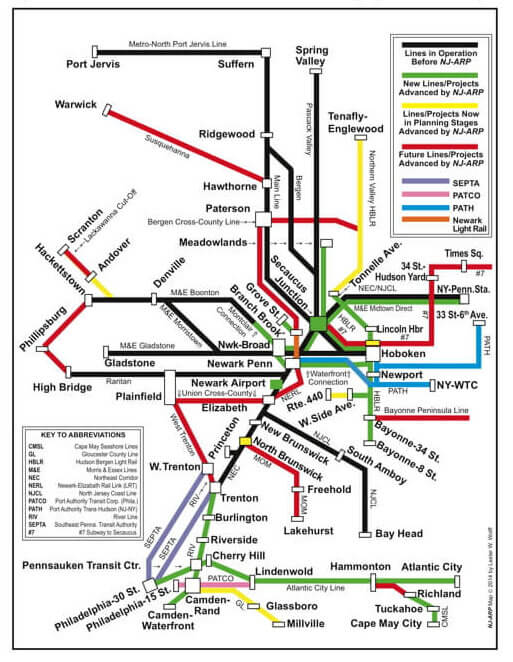
New Jersey Transit (NJT) opened its Pennsauken Transit Center, built to allow passengers to transfer conveniently between its River Line and Atlantic City Rail Line, on Monday, October 14th. The new transfer station is located at Derousse and Zimmerman Avenues in Pennsauken Township, Camden County. In this area, the Atlantic City Rail Line is in an east-to-west alignment on an elevated approach to the Delair Bridge, a vertical lift structure crossing the Delaware River owned by Conrail Shared Assets and also used by freight trains of CSX Transportation and Norfolk Southern Railway.
The River Line, which follows a general north-to-south alignment at this point, passes under the Atlantic City Rail Line, making it a natural and obvious place for NJT to connect the two rail lines. The Pennsauken Transit Center has a 200 feet long mid-level platform with a 60-foot canopy along the eastern side of the River Line’s single track and two 300 feet long high-level platforms with 100 foot-long canopies on each side of the Atlantic City Rail Line’s double-tracked alignment. The two levels are connected by stairs and elevators, the latter in towers that rise approximately 38 feet from the surface, making the transfer station fully compliant with the American with Disabilities Act.
The new transfer station also is served by NJT’s No. 419 bus line, which more or less parallels the River Line between Camden and Burlington making frequent stops in areas not close to light rail stations. The station also has 270 free parking spaces.
NJT’s ridership forecast for the Pennsauken Transit Center, prepared in 2008, anticipates that 570 riders (1,140 trips) will board Atlantic City Rail Line and River Line trains at the transfer center on a typical workday in the target study year of 2015. Of these, 420 passengers are expected to board locally, i.e. will not be rail-to-rail transferees. If that projection were to prove correct, only 150 passengers (300 trips) will transfer between the two rail lines.
The most recently released statistics for the River Line indicate that, in NJT’s Third Quarter of its Fiscal Year 2013 (January through March 2013), the River Line carried 8,800 passengers on weekdays, 5,500 on Saturdays and 4,150 on Sundays. During the same period, the Atlantic City Rail Line carried 2,500 passengers on weekdays, 2,800 on Saturdays and 2,150 on Sundays. How the Pennsauken Transit Center will affect the ridership on both of these rail lines, one with frequent even interval service and the other with less frequent sporadic service, may not be known for a year to come but nevertheless will be of interest when the numbers become available to the public. NJ-ARP’s expectation is that they will be greater than and include more rail-to-rail transfers than those projected several years ago.
The Pennsauken Transit Center was proposed in the late 1990s for inclusion in the original construction of the River Line, but was deferred by the administration of Governor Christine Todd Whitman (R) to reduce the capital investment requirements of the overall project that was being financed entirely by the New Jersey Transportation Trust Fund.
Upon taking office in 2002, Governor James McGreevy (D) stated that were the River Line not in an advanced state of construction under a Design-Build-Operate-Maintain (DBOM) contract, he would have canceled the project. When the River Line was opened on March 14, 2003, the late George Warrington, Governor McGreevy's appointee as NJT’s Executive Director, was quoted as saying that the River Line is “… the poster child for now not to plan and make decisions about a transit investment.” With these attitudes towards the River Line being expressed in Trenton and Newark, delivered with a heavy partisan political overtone, there was no interest by NJT in developing a Pennsauken Transit Center regardless of any merits it might have
Six and a half years later, in the run-up to that year’s gubernatorial election, in which then Governor Jon S. Corzine (D) was making his unsuccessful bid for re-election, New Jersey Transit’s Board of Directors responded to criticism over the omission of the Pennsauken Transit Center, authorized its construction on September 16, 2009. A ground breaking was held on October 19, 2009 for what was announced as a two-phase construction project expected to be completed in December 2012. With Governor Chris Christie (R) in office, the current NJT Board approved completing the transfer station project on July 13, 2011. Notwithstanding the stops and starts along the way, and politics aside, the new rail-to-rail transfer station is opened at last.
The Pennsauken Transit Center has a project budget of $40,644,000, with 90 percent or approximately $36 million being provided by the Federal Transit Administration under the American Recovery and Revitalization Act (ARRA) and the remainder by the State of New Jersey through NJT’s Capital Investment Budget.
The October 14, 2013 timetable for the Atlantic City Rail Line (ACRL) shows connections at the Pennsauken Transit Center between its trains and those of the River Line to and from Trenton only; surprisingly, no connections to and from 30th Street, Philadelphia are shown even though that may turn out to be a major market and source of new ridership for both lines. Inasmuch as the River Line run almost exclusively on even interval 15-minute or 30-minute headways in classic transit style while the trains of the ACRL are operated with seemingly random departures from Atlantic City and Philadelphia, the waiting time between trains at the Pennsauken Transit Center vary considerable in duration. They are in a range of 17 to 27 minutes on weekdays from River Line southbound to ACRL eastbound and in a range of 6 to 23 minutes from ACRL westbound to River Line northbound. Connecting time on weekends and holidays are even worse at times, being as long as 34 minutes between the arrival and departure of trains.
Why so long when the River Line runs on 30 minute-headways? Because of the lack of through ticketing for passengers buying adult tickets or reduced fare [senior/disabled/youth] tickets; the time it will take to move from one platform to the other; and because of late operations, most likely on ACRL. And because NJT Rail Operations, which manages ACRL, does not seem to be willing to run even interval services (other than when forced by Amtrak to do so into and out of New York’s Penn Station because of single-track operations through the North River Tunnels to allow maintenance to take place). Surely, when there are close connections at the Pennsauken Transit Center, some nimble passengers will manage to run up or down the stairs and throw themselves onto a train about to close its doors and depart, hopefully having validated or pre-purchased tickets that will enable them to avoid a $5.00 onboard purchase penalty (ACRL) or a summons resulting in a $100.00 fine for traveling without validated Proof-of-Payment (River Line).
Fares on the Atlantic City Rail Line to and from the Pennsauken Transit Center are the same as those to and from the Cherry Hill Station, located 4.5 miles to the east. They are as follows:
River Line fares are as follows:
Analyzing the fare structures in place as of October 14, 2013, it appears that New Jersey Transit does not have a strong interest in promoting ridership between points on the River Line and Philadelphia via its Atlantic City Rail Line. Otherwise, it would have set lower fares between the Pennsauken Transit Center and 30th Street, Philadelphia – say $2.50 one-way tickets and $1.25 one-way senior/disabled/youth tickets, as well as comparably cheaper monthly and weekly passes. For the convenience of its occasional passengers, NJT also would have established through tickets [other than monthly and weekly rail passes] valid for travel between all stations on its commuter rail system and the River Line. Indeed, the New Jersey Association of Railroad Passengers brought this issue up before New Jersey Transit’s Board of Directors at their May 8, 2013 meeting. Having received no response since then, we assume that our recommendation fell on deaf ears.
The Evil Deed is Done – Princeton Branch Decapitated:
The last Princeton Branch train departed from the historic 1918 Princeton Station for Princeton Junction at 1:27 AM on Saturday, August 23rd, bringing 95 years of railroad passenger service to – listed on the National Register of Historic Places – to a close. After a weekend of bus substitution, Princeton Branch trains began departing from a “temporary” station located approximately 1,200 feet from the previous station on Monday, August 26th.
Notwithstanding what was about to take place, Save The Dinky filed papers with the New Jersey Chancery Court asking it to issue temporary relief by stopping New Jersey Transit and Princeton University from relocated the Princeton terminus of the Princeton Branch. The judge turned down the request for a temporary restraining order but agreed to hear the case on November 1st. Princeton University told the Chancery Judge that the University would pick up the bill and pay NJT’s restoration costs in the event that the court finds the NJT has violated its legal obligations, so there is some faint hope.
This situation is akin to a condemned person waiting a stay of execution. The stay may be granted after the prisoner has been executed and his lifeless body buried in a potters field but the law has been decided in his favor. In this case, the party who falsely accused him of a capital crime will pay all costs involved.
It seems that Princeton University, which has a trust fund worth $18 billion dollars, has enough money to pay for whatever the price tag might be if NJT is forced to restore railroad passenger service to the historic station so that Princeton Branch can operate again as it always has. Clearly, neither PU nor NJT have any qualms of conscious over inconveniencing over a thousand passengers on a daily basis, as well as isolating Princeton’s railroad station to a desolate location over a half mile from Palmer Square, the heart of the Borough. Creating “facts on the ground” fast as they could,
New Jersey Transit and Princeton University went to work as fast as they could. New catenary poles had been placed at the temporary station and a bumper block was installed at it over the weekend. NJT then began removal of the track and catenary leading to its just-abandoned historic station. As soon as this was finished, PU’s contractors leveled the embankment and re-graded the area to allow construction of an access road, in reality a driveway, leading to its Lot 7 parking garage; the desire to avoid constructing a grade crossing at this point being the reason for decapitation of the Princeton Branch.
Simultaneously, one of PU’s contractors attacked the station’s high-level platform, jack hammering into its surface. This resulted in PU scoring an “own goal” when its contractor, working without a proper permit from the Borough of Princeton, managed to collapse the canopy of the historic station into the adjacent track bed, nearly killing five construction workers in the process. The remnants of the canopy, dating from 1918 and whose removal was approved by the New Jersey Department of Environmental Protection even though it was part of a listed structure, where unceremoniously carted off to a land fill.
As a partial replacement for the cut-back railroad service, Princeton University is operating a bus line – dubbed “Tiger-PaWW” for Princeton/West Windsor – between the former station on Princeton’s University Place and Princeton Junction. PU says that it will run this service for at least a year unit the permanent station within its so-called Arts and Transit Project is opened, currently projected to be in the third quarter of 2014. This “supplementary” bus service runs along Alexander Street/Alexander Road and Vaughn Drive, which are heavily congested during weekday peak hours.
The bus schedules posted online at PU’s website indicate that buses will run from approximately 5:00 AM to 1:30 AM, seven days per week. These schedules, which differ slightly between weekdays and weekends/holidays, are based on meeting all of NJT’s Trenton-bound Northeast Corridor trains (those originating at New York Penn Station) following their arrival at Princeton Junction. Pointedly, there is no guarantee that the Tiger-PaWW buses will connect with any New York-bound trains departing from Princeton Junction. The only remedy for commuters concerned with making sure that they can get to work on time is “Start Earlier.”
NJ-ARP does not quarrel with PU’s proposed arts center project. It will benefit the Princeton community. But, if the federal and state governments saw fit to allow a six-lane highway to have a grade crossing across the throat of the Atlantic City Rail Terminal, we cannot understand why NJT and PU cannot accept a two-lane crossing of a single-tracked railroad line adjacent to an existing parking garage. We can only conclude that the only reason that NJT and PU can get away with what they have done is because Governor Chris Christie has placed the full powers of the State of New Jersey at the disposal of Princeton University, a private entity of which he is a Trustee. NJ-ARP holds that this involves an actionable conflict of interest, which in and of itself is reason for the “decapitation” of the Princeton Branch to be reversed.
NJ Transit NJ Transit Rail Fleet Status Report:
As was committed by James Weinstein, NJ Transit’s Executive Director, at the New Jersey Transit Board Meeting held on Wednesday, April 9, 2013, this information is being updated every two weeks. The information presented below is as of October 15, 2013. A further update is expected before the next meeting of board, currently scheduled currently to take place on November 12, 2013. The Superstorm Sandy Recovery Progress Card is posted on the state transportation agency’s website under the heading Repair, Recovery and Resiliency Projects, which in addition to that relating to rolling stock, contains considerable additional information relating to infrastructure.
In the three-month period since July 12th (the date of the last update reported in The Hot Wire), 29 multilevel coaches, 6 multiple-unit electric cars, 10 single level coaches, 2 dual powered locomotives, 7 electric locomotives, and 2 diesel-electric locomotives were returned to service.
The 17 locomotives that remained out of service included 9 ALP-45 DP dual-powered locomotives owned by NJ Transit, 4 ALP-46 and ALP-46A electric locomotives, and 4 diesel-electric locomotives. During this period, NJ Transit look delivery of 17 newly-built multilevel coaches but, interestingly, also increased the number of multilevel coaches that it had reported damaged by Superstorm Sandy from 84 to 85.
Compared to the information made public on April 9th, NJ Transit has added 17 multilevel coaches to its passenger car fleet and returned 58 multilevel coaches, 35 Jersey Arrow III multiple-unit electric cars, 107 single level coaches, 2 dual powered locomotives, 7 electric locomotives and 46 diesel-electric locomotives to service. NJT also accepted 3 additional ALP-45DP locomotives, increasing the number of these electric/diesel-electric locomotives on its roster to 26.
As of October 15th, 73 passenger cars and 17 locomotives owned by NJ Transit remained awaiting repairs, almost one year after Superstorm Sandy struck on October 29, 2012. In addition, 9 dual powered locomotives that had not completed testing prior to acceptance by NJT and were at the Meadowlands Maintenance Center when they were damaged floodwaters, remain awaiting repair, re-delivery and acceptance before they will be available for passenger train service. The repair of these locomotives, which never saw revenue service, was deemed the responsibility of Bombardier rather than NJ Transit and has not been included in Superstorm Sandy Recovery Progress Card. Thus, 18 of the 35 ALP-45DP locomotives that were purchased by NJT from Bombardier at an average cost exceeding $10.5 million apiece or a total cost exceeding $190 million were not available for passenger train service two weeks short of the first anniversary of when they were damaged during the hurricane.
State Legislators Urge FTA to Move on HBLR to Englewood:
New Jersey State Senators Loretta Weinberg (D-Bergen) and Gerald Cardinale (R-Bergen and Passaic) have urged the Federal Transit Administration (FTA) to speed up its review of the Final Environmental Impact Statement (FEIS) and the issuance of a Record of Decision (ROD) approving extension of the Hudson Bergen Light Rail system along the CSX Transportation’s ex-Erie Railroad Northern Branch to Englewood Hospital.
New Jersey Transit has been communicating for over a year and a half with the Region 2 of the FTA, which has its office in New York City, about the required content of the FEIS following the public hearings that were held on the Draft Environmental Impact Statement (DEIS) in early 2012. At that time, two build alternatives were being considered for the Northern Branch Corridor Project, either terminating HBLR near the Leonia/Englewood boundary at a Route 4 station with a park-and-ride lot or extending it through the Englewood and Tenafly business districts to a North Tenafly station with a large park-and-ride facility just south of the Tenafly/Cresskill boundary.
The implacable opposition of local NIMBYs to having HLBR serve their community, orchestrated in large measure by Tenafly’s Mayor Peter Rustin, resulted in a political consensus that, in accordance with the wishes of the City of Englewood, the light rail transit line must serve Englewood’s business district and Englewood Hospital but, at least for now, not cross the Englewood/Tenafly boundary. This decision leaves the five communities along the Northern Branch located north of Tenafly (Cresskill, Demarest, Closter, Norwood and Northvale) urging the Bergen County Board of Chosen Freeholders that HBLR be extended to serve them in a future phase even if it requires “closed door” operations through Tenafly.
At its May 8, 2013 meeting, New Jersey Transit’s Board of Directors approved an amendment to the state agency’s contract with Jacobs Engineering, Inc. for consulting services involving additional engineering and planning activities to complete the FEIS for the Northern Branch Corridor Project at a cost not to exceed $3,000,000 plus five percent for contingencies. NJT’s Executive Director, James Weinstein, said that this work was expected to take two years, i.e. to extend into 2015.
With that rate of progress, it would be unlikely that HBLR to be extended beyond Tonnelle Avenue, North Bergen (which is in Hudson County) into Bergen County before 2020 at the earliest. And that assumes that the requisite state and/or local matching funds would become available to match a federal contribution of at least 50 % under a Full Funding Grant Agreement. NJT estimates that the capital investment requirements for the Northern Branch extension are in the range of $800 million (in current funds), a number that can only be expected to grow as time passes.
MTA Orders 92 M-9 MU Cars for Long Island Rail Road:
The Board of the New York State Metropolitan Transportation Authority (MTA) approved a contract with Kawasaki Rail Car, Inc. on September 18th for up to $1.83 billion to design and build the next generation of electric multiple unit cars for the Long Island Rail Road and Metro-North Railroad. The initial contract will provide 92 cars to the LIRR. If funding is available in the forthcoming 2015-2019 MTA Capital Plan and the railroads choose to exercise future options, Kawasaki will manufacture up to 304 additional cars for the LIRR and up to 280 cars for Metro-North.
The M-9 cars will be used to replace M3 cars, placed in service between 1984 and 1986, that operate on the LIRR’s eight electrified branches and Metro-North’s Harlem and Hudson Lines and to expand fleet capacity for both railroads to allow for ridership growth. Originally, there were 174 LIRR M-3s and 142 MNR M-3As; over the years, there have been a few cars withdrawn from service in each group. Assuming that the LIRR’s option is exercised, the M-9s also will provide the additional rolling stock required to permit it to begin revenue service to and from Grand Central Terminal upon completion of the MTA’s East Side Access Project in 2019.
The M-9 cars will incorporate the most successful and popular features of the two railroads most recent MU car classes, the M7s that serve the LIRR and Metro-North’s Harlem and Hudson Lines, and the M8s serving Metro-North’s New Haven Line. The cars will have larger windows than the M3 cars they are replacing, automated public address announcements in car interiors and exteriors, and single leaf doors for improved reliability. They will also continue the M7/M8 configuration for heating, ventilation and air conditioning systems that has proven to be more resilient in extreme weather and more effective at providing customer comfort in all types of weather conditions.
The MTA stated that it benefited from robust competition for this contract. With the LIRR acting as its lead agency, the MTA initially advertised a Request For Proposals (RFP) for the cars in June 2012. Twelve railway car builders received initial RFP packages from the MTA containing required technical details of the cars. After initial consultations, the MTA determined that six of them were qualified to submit initial price and technical proposals, and three ultimately did so. These were Bombardier, CAF and Kawasaki. Best and final offers from each of the responding car builders were received in August 2013.
The proposals for the contract were evaluated on a host of financial and technical criteria, including price, percentage of New York State content going into the cars, and the percentage of U.S. domestically produced steel used in the cars. The winning bidder, Kawasaki, provided the most attractive pricing.
In announcing the M-9 award, Governor Andrew M. Cuomo stated that MTA expects up to 676 cars will be assembled at Kawasaki’s plant in Yonkers and anticipates up to 1,500 people will be employed in New York State.
NYCT Inaugurates Q70 Limited Bus from Woodside to LaGuardia:
MTA New York City Transit began operating a new Q70 Limited bus service between the Woodside Station of the Long Island Rail Road, the Jackson Heights-Roosevelt Boulevard subway station and Terminals B, C and D at LaGuardia Airport on Sunday, September 8th.
The LIRR’s announcement about the new bus line quoted MTA Chairman and Chief Executive Officer as saying “This new service is a great example of how the MTA network uses buses, railroads and the subway system to service our customers’ needs.” Woodside is a regular stop for many LIRR trains; passengers can transfer to and from those that do not stop at Woodside at Jamaica. While publicized by the LIRR as being instituted for the convenience of its passengers, the new service also benefits riders of the No. 7 Times Square-Main Street, Flushing subway line, which also has a 61st Street-Woodside station, as well as the E, F, M and R lines at Jackson Heights-Roosevelt Boulevard Station.
The new bus line takes between 10 to 15 minutes, depending upon traffic conditions, to travel between Woodside and LaGuardia. Much of its route is along the Brooklyn-Queens Expressway and the Grand Central Parkway, avoiding meandering through local streets. The Q70 Limited is operated 24 hours per day, 7 days per week at headways that vary between 12 and 30 minutes but typically are either 15 or 20 minutes. Regular MTA NYCT fares are charged on the new bus line, which certainly enhances its attractiveness to both airline passengers and aviation industry employees.
WMATA Increases Order for New Rapid Transit Cars:
The Washington Metropolitan Area Transit Authority has exercised an option under its contract with Kawasaki to purchase 220 additional 7000-series rapid transit cars at a cost of $1.5 billion. This brings the total number of cars on order to 748, with the delivery of all cars expected by the end of 2018. The first four pilot cars are to be delivered during the fourth quarter of this year and will be undergo testing and employee training before being placed into revenue service in mid-2014. The 7000-series cars will not be operationally compatible, i.e. train-lined, with older cars, suggesting that additional cars will have to be delivered and tested before the new series can be operated in the six-car or eight-car consists required for normal service.
After Kawasaki begins delivering series-production cars, the 7000s will replace the remainder of the 1000-series cars built by Rohr Industries for the 1976 opening of the initial segments of the Metrorail system. Originally a fleet of 300, less the 290 of the 1000s survive as the result of accidents that occurred over their three plus decades of use, including a fatal collision on June 22, 2009 that took 9 lives and resulted in the National Transportation Safety Board declaring them to be unsafe. Within a year, WMATA had placed its initial order for the 7000-series cars.
The option for 220 additional cars exercised this year will allow WMATA to retire its 4000-series cars, built by Breda Costruzioni Ferroviarie, now known as Ansaldo Breda. Metro’s Board Chairman Thomas Downs has called the 4000s “the dogs of the fleet” because of the endemic problems with brakes, lights, doors and air-conditioning that WMATA has experienced with them. Delivered between 1992 and 1994, these 100 cars would have required a major mid-life overhaul if they were to be retained as the fleet; WMATA’s decision was to junk them and buy new instead.
The addition of the Silver Line, which will extend Metrorail service in Northern Virginia from East Falls Church through Tysons Corner to Wiehle-Reston East, will require 128 cars, included in the 7000-series order, when it opens in early 2014. Its second phase extension to Dulles International Airport and beyond in Loudoun County will require even more cars to be added to the WMATA fleet. While acquisition of the 7000s will allow some of WMATA’s trains to be lengthened to eight cars to relieve crowding – now becoming a problem during off-peak periods as well as during weekday rush hours – making all trains into 8-car consists will require even further expansion of the rapid transit car fleet.
Coming Events
NJ-ARP Annual Meeting to be held on October 26th: The 2013 Annual Meeting of the New Jersey Association of Passengers will be held in Camden County on Saturday, October 26, 2013. We will begin with a luncheon at the Café Gallery, 219 High Street, Burlington, New Jersey. The restaurant is a short distance towards the Delaware River (west) along High Street from the Burlington Towne Centre station of NJT’s River Line. Parking also is available on site.
Our meeting will start at 12:00 Noon: Our speakers will be John Conlow, Amtrak’s Senior Director of Northeast Corridor Planning, and Bob Scarlott of the South Jersey Transportation Authority. The meeting will end in time for us board the 2:08 PM southbound River Line train and ride it the Pennsauken Transit Center, arriving at 2:34 PM. [There also will be a 2:38 PM southbound train from Burlington which attendees can ride if the meeting runs a little longer than planned or if there are a few stragglers]. Northbound River Line trains depart from Pennsauken for Trenton at 2:59 PM, 3:29 PM and every 30 minutes thereafter. Atlantic City Rail Line trains will depart from the Pennsauken Transit Center for Atlantic City at 2:58 PM and for 30th Street Station, Philadelphia at 3:57 PM.
Please see our Calendar of Events for updated information.