

Current News
Next US Secretary of Transportation to be Anthony Foxx:
As predicted by the national and local news media on Sunday, April 28th, the following day President Barack Obama nominated Anthony R. Foxx, the Mayor of Charlotte, North Carolina, to become the next Secretary of the United States Department of Transportation as this edition of The Hot Wire was being completed. Mr. Foxx will replace Raymond H. LaHood, who has served as Secretary of Transportation since early in the President’s first term and will remain in office until the United States Senate confirms the nomination of his replacement. Mr. LaHood, a Republican, previous represented Illinois’ 18th Congressional District (central and southwestern Illinois including Peoria and Springfield) in the House of Representatives. The President praised Secretary LaHood for his service to the nation, both as a member of his Cabinet and in Congress.
Mr. Foxx, a Democrat, was the recipient of considerably national attention last summer when Charlotte hosted the Democratic National Convention. An attorney, he announced earlier this month that he would leave the mayoral office by the end of this year saying “I never intended to be mayor for life.”
In announcing his nomination of Mr. Foxx, the President said:
During his four years as Mayor of Charlotte, Mr. Foxx supported extending the Lynx light rail transit line (which currently runs for 9.6 miles from 7th Street in Charlotte’s Uptown District south to Interstate 485 at the Pineville city limits) northeast by another 9.3 miles to the University of North Carolina-Charlotte’s University City Campus. A Full Funding Grant Agreement (FFGA) with the Federal Transit Administration (FTA) is in place committing the US Government to provide $580.04 million in New Starts funds or 50 percent of the estimate $1,160.08 million cost of the project. The State of North Carolina will provide $299.07 million, with the remaining $280.97 million coming from the City of Charlotte. With final design complete, construction is to start in 2014 and revenue service to begin in 2017. Mayor Foxx also secured a $25 million Federal Urban Circulator Grant from the FTA, announced in 2010 by Secretary LaHood, towards construction of a 1.5 miles-long east-west streetcar line in Downtown Charlotte, now under construction, that will connect with Lynx at the Charlotte Transportation Center. Recently, Mayor Foxx has been battling with conservative members of the Charlotte City Council opposed to using funds generated through property taxes to expand the streetcar project.
As an omen of what to expect should Mr. Foxx become the United States Secretary of Transportation, The Charlotte Observer reported that he “… is interested in how transit can shape urban development, and he shares the Obama administration’s support for high-speed rail and creating walkable cities with development clustered around transit stops.”
NJ Transit Prepares to Decapitate the Princeton Branch:
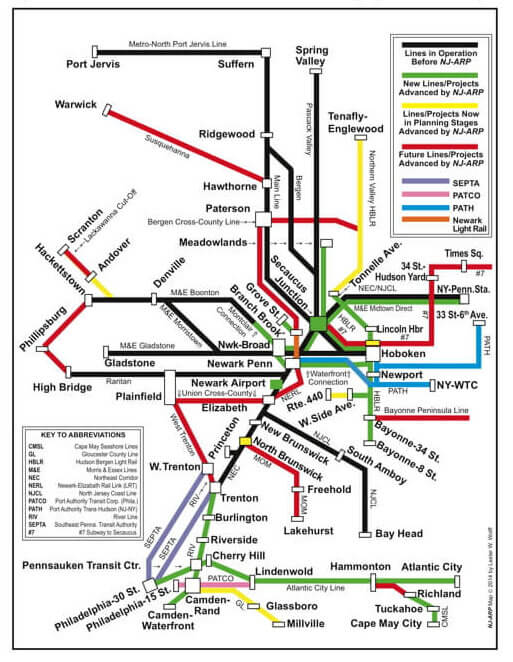
In support of Princeton University’s Arts and Transit Center Project, New Jersey Transit is getting ready to cut the Princeton Branch back by approximately 1,210 feet from the existing Princeton Station to a temporary station near the southern end of the University’s campus. Heretofore, the public discussion has been that the Princeton Branch is to be cut back by 460 feet to a new permanent station; the temporary station, however, will be located 750 feet further south. When added to the existing approximately 1,600 feet between Nassau Street and the location of the existing station, the temporary station will be approximately 2,800 feet from the center of Princeton. That is over a half mile as the crow flies; the actual distance that a pedestrian, motorist or bicyclist will have to traverse will be substantially greater.
Princeton University bought approximately 2,000 feet of the Princeton Branch right-of-way from the New Jersey Department of Transportation, extending from the original 1918 station building (about 100 feet north of the current end-of-line at the former Railway Express Agency building) south to Faculty Road, in 1984. The University’s current motivation in pressing New Jersey Transit to surrender 460 feet of its perpetual easement is to allow an access road to be built across the right-of-way to an existing multi-story parking garage. Ripping out the railroad, rather than building a grade crossing, will relieve patrons of the Princeton University Arts Center venues of the annoyance of having to stop and wait for the occasional one-car or two-car Jersey Arrow III electric multiple unit cars that operate on “The Dinky” – as the Princeton Branch is referred to locally – to pass through. Indeed, Shirley Tilghman, PU’s retiring President, haughtily stated “I will not have a train on my campus” at a public meeting held in Princeton in 2011 to provide information about the project to the community’s residents.
Kevin J. O’Conner, Vice President and General Manager of New Jersey Transit Rail Operations, Inc. (NJTRO), approved issuance of a “Temporary Access Permit” to Princeton University (PU) and Turner Construction Company (TCC), the University’s contractor, on March 27, 2013. This permit allow PU and TCC to enter onto the Princeton Branch right-of-way in the presence of NJTRO flagmen for the purpose of:
This access permit was reviewed and approved as to form by Jeffrey S. Chiesa, Attorney General of the State of New Jersey. Mr. Chiesa reports to Governor Chris Christie, who also is a Trustee of Princeton University. With this relationship in place, one might conclude that Princeton University gets whatever it wants from any agency of the State of New Jersey.
The cutback of the Princeton Branch to the temporary station is scheduled to go into effect in September 2013 and is expected to last for at least nine months, i.e. until June 2014 at the earliest. During this period, Princeton University will provide a shuttle bus service from the existing station on University Place to the temporary station. It will be routed by way of Alexander Street, which is heavily congested with motor vehicle traffic during the weekday AM and PM peak periods. After stopping at the temporary Princeton Station, the University’s bus service will return to Alexander Street and continue south across the Delaware and Raritan Canal into West Windsor, follow Alexander Road to US Route 1, which must be crossed at a traffic light controlled intersection with multiple “jug handles” and entrance and exit ramps, continue via Alexander Road and Vaughn Drive and eventually reach the Princeton Junction Station. At this location on the Northeast Corridor, Princeton Branch passengers can connect with New Jersey Transit trains to and from New York City and Trenton, as well as Amtrak trains running southbound or westbound to Philadelphia, Harrisburg and Washington, DC and northbound or eastbound to New York City.
Princeton University’s plan to run buses from the existing Princeton Station to the temporary station and then continue on to Princeton Junction supposedly is designed for the convenience of those passengers who do not wish to transfer twice (bus-to-train and train-to-train or vice versa) in order to travel between Princeton, Princeton Junction and points beyond. When the planned permanent station is opened in July 2014 (assuming no delays during construction), the walking distance from the existing station for able bodied passengers – as shown on plans that Princeton University was obliged to file with the Borough of Princeton – will be increased by approximately 700 feet; for wheelchair users and other persons with mobility limitations who require an ADA-compliant route, the additional distance they must negotiate will be approximately 1,100 feet.
The 460 feet cutback of the railroad – brushed-off so often by PU’s spokesman in the context of “What’s another 460 feet?” – turns out to be the straight line “as the crow flies” length of track to be abandoned under PU’s Arts and Transit Center development, not what an individual must face. Now that the University has received all of the approvals that it needs to go ahead, Robert Durkee, its Vice President, told the Planet Princeton, an online newspaper, “If you are driving to the Dinky you will have no problem pulling in, parking, and getting on and off the train. But if you are walking, this is a long walk. [That’s why] We are proposing to put in an express bus service in place back and forth between Princeton and Princeton Junction.”
According to New Jersey Transit’s Quarterly Ridership Trends Analysis for the First Quarter of Fiscal Year 2013 (July through September 2012) indicates that an average of 1,021 passengers boarded Princeton Branch trains at the Princeton Station on weekdays; assuming an equal number of passengers returning from Princeton Junction to Princeton, the Princeton Branch currently carries over 2,000 one-way passengers on weekdays. How much of that ridership will be left when Princeton University and New Jersey Transit get through with their current plans remains to be seen. One sure thing is that neither the “temporary” arrangement nor the permanent “decapitation” of the Princeton Branch are going to encourage existing and prospective future passengers to use the railroad service. But won’t the performances in the Arts Center venues be grand?
NJ Transit Rail Fleet Status Report:
As was committed by James Weinstein, NJ Transit’s Executive Director, at the New Jersey Transit Board Meeting held on Wednesday, April 9, 2013, this information is being updated every two weeks. The information presented below is as of April 23, 2013. The Superstorm Sandy Recovery Progress Card is posted on the state transportation agency’s website under the heading Repair, Recovery and Resiliency Projects, which in addition to that relating to rolling stock, contains considerable additional information relating to infrastructure.
Compared to the information made public on April 9th, NJ Transit had returned one additional single level coach to service during the two weeks ending on April 23rd: the status of all other rolling stock categories remain the same.
NJ Transit Begins Test of Smartphone Ticketing: New Jersey Transit (NJT) began a three-month test on last Thursday, April 25th allowing passengers to use smartphones to purchase one-way tickets and monthly passes on its Pascack Valley Line and its Meadowlands Rail Line between New York Penn Station and the Meadowlands Rail Station (via Secaucus Junction) during special events. In order to take advantage of this program, passengers must have downloaded the free My Tix application at the App Store for iOS equipped phones and Google Play Store for Android devices. After the test period is over, the state transportation agency expects to make any changes that are needed and then expand the program to cover all of its railroad lines by the end of this year.
New Jersey Commissioner of Transportation and NJT Chairman James S. Simpson said “Giving customers the ability to purchase and display rail tickets right from their phones will make traveling on NJ Transit trains even more convenient for the customers who use our system every day. Although the initial pilot is for our Pascack Valley and Meadowlands Rail Line customers, our ultimate goal is to put this technology into the hands of all of our rail customers.”
NJT chose the Pascack Valley Line (PVL) for the test because it has a smaller ridership level and more consistent train crew and equipment assignments than its other railroad lines. During the first quarter of its Fiscal Year 2013 (July to September 2012), the Pascack Valley Line had the highest growth in ridership of all of NJT’s railroad lines. It was the busiest quarter for the line in decades, with average weekday ridership reaching 7,470 boardings. The burgeoning ridership on the Pascack Valley Line is a direct result of adding trains, including two weekday round trips operated by NJT on behalf of MTA Metro-North Railroad that board or discharge passengers at Spring Valley, Nanuet and Pearl River in New York State’s Rockland County and then run express through New Jersey to and from Secaucus Junction and Hoboken.
Adding further service to Bergen County stations would require constructing a passing siding at Oradell on the single-tracked PVL that was blocked by local NIMBYs who claimed it would result in 120-car freight trains being introduced on the former New Jersey and New York Railroad, which has not had a connection beyond Spring Valley to another railroad line since the 1970s; neither are there any local on-line industries that would generate such traffic, either as receivers or shippers. “Please do not attempt to confuse us with facts; we know what we want to believe.”
LIRR Cannonball to Run From and To New York Penn Station:
MTA Long Island Rail Road announced on April 18th that it will begin running the summer season Cannonball express train service between New York Penn Station (NYPS), the Hamptons and Montauk beginning on Friday, May 24th through Monday, September 2nd (Labor Day). Dating back to 1899, in previous years the Cannonball originated and terminated its trips at Hunters Point Avenue, Queens. Until 1925 – long after the 1910 opening of Pennsylvania Station and the East River Tunnels – the passengers riding the Cannonball (and other trains) could use LIRR ferries that ran between Long Island City and 34th Street, Manhattan. Now, for the first time in 102 years since the opening of NYPS, the Cannonball will run through between Midtown Manhattan and the far end of Long Island’s South Fork. It will do so using two of the LIRR’s DM30AC dual-powered locomotives and up to 12 of its C-3 bi-level (double deck) coaches.
The eastbound Cannonball will depart from NYPS on every Friday and on Wednesday, July 3rd at 4:07 PM for a non-stop run to Westhampton where it will arrive at 5:41 PM and then continue to Southampton arriving at 6:03 PM, East Hampton arriving at 6:25 PM, and ending its trip at Montauk at 6:48 PM. Its 76 mile-long non-stop run from NYPS to Westhampton will take 94 minutes at an average speed of 48.5 miles per hour; its 117 miles-long trip to Montauk will average 43.6 miles per hour including three intermediate station stops. While these average speeds may not sound very fast, they certain will be much higher than those that a motorist or bus passenger can expect beginning in Midtown Manhattan on a trip through the Queens Midtown Tunnel and along the Long Island Expressway and the Sunrise and Montauk Highways.
The westbound Cannonball will run on every Sunday except on the Memorial Day Weekend and Labor Day Weekend, when it will run on Monday, May 27th and Monday, September 2nd. It also will run on Thursday, July 4th, Independence Day. On these days it will depart from Montauk at 6:37 PM, East Hampton at 7:01 PM, Bridgehampton at 7:10 PM, Hampton Bays at 7:31 PM, Westhampton at 7:39 PM and Jamaica (discharging passengers only) at 9:11 PM and arrive at NYPS at 9:31 PM. With five intermediate stops, its average speed will be 40.3 miles per hour, which will still beat driving or taking the bus from the South Shore to Manhattan on a summer Sunday or Holiday evening.
The Cannonball will carry passengers to and from the LIRR’s Fare Zone 14, in which the one-way peak fare is $27.00 and $13.50 for senior citizens and disabled riders. The railroad also is offering a Hamptons Reserve Service for this train for $47.00 when purchased in advance. This includes the one-way peak fare of $27.00 plus a reserved seat charge of $20.00, which includes snacks and beverages that will be served to passengers at their seats by attendants. The rear two coaches of the Cannonball will be reserved for the exclusive use of those passengers who chose the premium service, the only service of its kind to be found in North America on the suburban and regional railroads (other than long distance trains run by Amtrak and Via Rail Canada).
Amtrak’s Gateway Tunnel to Impact LIRR West Side Yard:
Amtrak’s Gateway Project, requiring construction of the an 800 feet-long concrete structure under Long Island Rail Road’s West Side Yards in Manhattan, located west of Penn Station, will require maintenance activities currently being performed there to be moved to Hillside Yards in Queens for more than two years. Related Companies, the developer of Hudson Yards – a major commercial and residential project above the West Side Yard – must install structural supports for its project in the same location. This necessitates that the work required for Gateway proceed first. Construction of the Gateway Tunnels will require use of tunnel boring machines (TBMs) to build two tubes under Bergen Hill (the southern end of The Palisades) and the Hudson River from North Bergen, New Jersey to New York’s Penn Station.
One of the Gateway Tunnels will run directly under the LIRR’s inspection and light maintenance shop, located on the southern side of the West Side Yard. Amtrak will reimburse the LIRR for the cost of its demolition and construction a new shop in the future. It also will pay LIRR for moving and increased operational expenses at its Hillside Yard.
Helena Williams, LIRR’s President, was quoted by Newsday as saying “If we had our druthers, would we be doing this? No, but we recognize that we’re in a region where intercity rail’s future is important, and we’re cooperating.
Amtrak issued a statement saying “Building a new set of modern tunnels is essential to ensure flooding like that seen during Hurricane Sandy won’t again shut down the nation’s busiest rail station.” Amtrak added that the work will be done in cooperation with the MTA and LIRR and hopes to begin construction of a concrete casing to protect this potential tunnel right-of-way in the summer of 2013.”
Denver Opens West Light Rail Line:
The Regional Transit District of Colorado (RTD) held a ceremonial opening of its West Light Rail line at the Jefferson County Government Center on Friday, August 26th, followed by free rides for the public for the rest of the day and on Saturday, April 27th. Regular scheduled service on the W Line, as it has been designated by RTD, commenced on Sunday, April 28th.
The West Light Rail Line is the first rail project to be completed under the RTD FasTracks program, opening eight months ahead of schedule and within its $707 million budget. Colorado’s Governor John W. Hickenlooper and U.S. Senator Michael F. Bennett (both Democrats) participated in the ribbon-cutting ceremony. Governor Hickenlooper said “This is an example of how fast-moving Colorado is. We will see little villages all along the FasTracks corridor where people will live and shop. And all the time we will be eliminating congestion and sing less carbon and less energy.”
The W Line extends for 12.1 miles between Denver’s Union Station and the Jefferson County Government Center Station in Golden. Its opening added 11 stations and six park-and-ride lots with 5,605 spaces to RTD’s light rail network, as well as Call’n’Ride van services that feed three of the new stations.
RTD anticipates that 19,300 passengers will ride the W Line on an average weekday in 2013. By 2030, its trains are expected to carry 29,700 passengers on an average weekday.
Service on Route 103/W Line is being operated eastbound departing on Mondays through Fridays from the Jefferson County Government Center Station in Golden for Denver Union Station between 4:14 AM and 12:29 AM the following day and on Saturdays, Sundays and Holidays from 2:29 AM to 12:29 AM on the following day. In the westbound direction, W Line trains depart on Mondays through Fridays from Denver Union Station for the Jefferson County Government Center Station between 4:51 AM and 1:01 AM the following day, and from 1:45 AM to 1:01 AM on the following day on Saturdays, Sundays and Holidays. Base headways are a train every 15 minutes in each direction, approximately between 5:30 AM weekdays/6:30 AM Saturdays, Sundays and Holidays and 9:30 PM every day, with 30-minute headways being operated before and after those periods. During weekend AM and PM peak periods, a 7.5-minute headway is being operated on the double-tracked section between the Federal Center Station in Lakewood and Denver Union Station. In addition, several pull-out and pull-in moves from RTD’s Elati Maintenance Facility are shown in W Line timetables as carrying passengers west of the Auraria West Campus Station (instead of being run as non-revenue “light train” movements).
The West Line has double track from Denver Union Station to the Denver Federal Center in Lakewood, after which it has single track for the remaining distance to the Jefferson County Government Center Station in Golden. There is an intermediate passing siding at the Red Rocks College Station, also in Golden. Unlike the unlike the two interurban electric railway lines (one standard gauge and the other narrow gauge) that connected Denver with Golden during the first half of the 20th Century, the W Line does not continue for another mile into the downtown of this city at the edge of the foothills of the Front Range of the Rocky Mountains, which has had its population grow from 2,382 in 1950 to 18,867 in 2010 according to the U.S. Census Bureau. Much of the West Line follows the right-of-way of the Denver and Intermountain Railroad (D&IM), a subsidiary of the Denver Tramways Company, which operated two interurban electric railway lines between Denver and Golden, one standard gauge and the other 3 foot, 6-inch narrow gauge.
The 13 miles-long standard gauge line was built by the Denver, Lakewood and Golden Railroad, which opened in 1891 and was operate by steam locomotives. The D&IM was electrified in 1909 after being acquired by the Tramways, which ran the interurban as its Route 84 until June 4, 1950 when passenger service was discontinued as part of converting Denver’s streetcar system to buses; freight service, operated by “steeple cab” electric locomotives, continued until March 15, 1953 when it was abandoned due to substantial operating losses.
The Rocky Mountain Railroad Club acquired D&IM car no. 25, which had been placed in service by the D&IM on February 17, 1911, for $150.00 on October 12, 1950. Its manufacturer was the Woeber Car and Carriage Company, a local carbuilder that supplied most of the streetcars of the parent Denver Tramways Company as well as the horse cars and cable cars of predecessor companies. Car no. 25 is a handsome double-ended interurban car with a wooden carbody mounted on a steel underframe. It was placed on the National Register of Historic Places on January 12, 2012. It currently is located at the Denver Federal Center in Lakewood, one of the stops on the West Light Rail Line.
The future vision for D&IM car no. 25 includes providing it with a permanent home in the Oak Street Transit Museum and Restoration Center, to be located at the Lakewood Station of the W Line. The museum will consist of two main areas, a restoration bay and a two-story area in which car no. 25 and other historic transit artifacts will be displayed. There will be provisions for the car to be brought outside during special events. Visitors will be exposed to the history and exquisite restoration of car no. 25, as well as the regional history of interurban electric railways.
Salt Lake City’s New Light Rail Line A Success:
The Utah Transit Authority (UTA), as reported in the April 1st edition of The Hot Wire, extended the Green Line of its TRAX light rail transit system to Salt Lake City’s International Airport on Sunday April 14th. Within a week, the Deseret News reported that about 4,800 passengers boarded the line from downtown stations during the first week of operation starting Monday, April 15th. This is above the 4,600 users of the Airport extension predicted for the end of 2013. The daily passenger count does not include passengers who already were on Green Line trains before others boarded at a downtown stop. Those boarding downtown include those transferring from the Blue Line (Sandy Civic Center to Salt Lake Central), the Red Line (Daybreak Central in South Jordan to the University of Utah Medical Center, and the FrontRunner regional railroad service, which runs from Ogden through Salt Lake City to Provo.
The Green Line, the shortest of the three TRAX lines, originates at West Valley Center and passes through several stations in the downtown area, as well as at the North Temple Bridge/Guadalupe Station where transfers to and from FrontRunner trains may be made, while en route to and from the airport. UTA’s spokesman, Remi Barron, said that analysts cannot determine how many passengers are getting off at the airport from electronic records but that Green Line trains are usually crowded with baggage-carrying passengers. The Church of Jesus Christ of Latter-day Saints announced that it was starting to use the UTA’s FrontRunner and Green Line trains, instead of buses or vans, to send Mormon missionaries to the airport from training centers in Ogden and Provo. This is an excellent example of the “network effect” in which opening a new line – or even serving a new station – opens up travel opportunities for the public that attracts new riders to existing lines as well as to the new one. “Plan it intelligently, build it, operate it frequently at affordable fares, and they will come” (as has been observed by NJ-ARP’s Light Rail Panel Member Frank Miklos).
Coming Events
Next NJ-ARP Board Meeting on May 18, 2013: The next meeting of the NJ-ARP Board of Directors has been scheduled for Saturday, May 18, 2013. It will be held in Chatham, N.J., at the Chatham Library, 214 Main Street, commencing at 10:30 AM. Please see our Calendar of Events for updated information. All currently-paid up members are welcome to attend and participate in the Board’s discussions. Those wishing to attend meetings are requested to please e-mail NJ-ARP at njarp@nj-arp.org at least three (3) weekdays prior to the meeting, leaving your name and phone number so that we can notify the venue how many members will be attending, as well as contact you with any late venue or time changes.