

Current News
NJ Transit Executive Director Admits It:
New Jersey Transit Corporation’s Executive Director, James Weinstein, while giving testimony before the New Jersey State Senate Budget Committee hearing held on Wednesday, April 3rd, acknowledged that the state-wide public transportation agency’s subsidiary, New Jersey Transit Rail Operations, Inc. (NJTRO), had moved rolling stock to the Meadowlands Maintenance Center (MMC) just before it was inundated on Monday, October 29, 2012 by Superstorm Sandy’s floodwaters, which surged from Newark Bay up the Hackensack River and into the wetlands immediately north of the MMC. Mr. Weinstein said “We brought some additional equipment in there to store during the storm”.
The Star Ledger quoted Mr. Weinstein as saying “We had a plan – it was a plan that was informed by Irene [the hurricane that made landfall at Little Egg Harbor on August 28, 2011 and flooded the Trenton railroad station and isolated much of the rolling stock that NJTRO needed to run its Northeast Corridor Line at the across-the-Delaware River yard in Morrisville, Pennsylvania].” Regarding Sandy and its impact on the MMC, the Executive Director said “It was the worst storm of anybody in New Jersey. That facility [opened in 1987] had never flooded before and it’s our primary maintenance repair and inspection facility.” He continued to maintain that “There was not reason to believe that it would flood,” although this assertion has been disputed by experts competent in forecasting the effects of hurricanes, especially those accompanied by high tides.
NJTRO experienced significant damage to 70 locomotives and 272 passenger cars at the MMC and in Hoboken. The Record reported that when it asked how many locomotives and passenger cars were moved to the MMC, NJ Transit spokesman John Durso, Jr. said “That specific information had not be previously provided due to security-related concerns” while failing to explain the nature of the security risk of making this information public. This prompted a highly respected attorney - now retired but who had headed the law department of another metropolitan area railroad - to comment “The security risk involved in withholding this information is job security.”
Unconfirmed reports have been circulating since last year that NJTRO had issued a last-minute order for movement of some of the rolling stock that was subsequently damaged by floodwaters to the six-track yard located in Waldwick, New Jersey on the former Erie Railroad’s Main Line – an order that was not carried out. Supposedly, a middle-level manager was suspended with intent to terminate but was subsequently reassigned to another position after Governor Chris Christie – defending NJ Transit - declared “Making a mistake is not a hanging offense.” It is known that some NJTRO off-duty employees who were offered overtime in the hours before the storm peaked refused to come to work out of fears for their personal safety and concerns that their automobiles would be damaged or destroyed.
NJ Transit Tracking Recovery from Superstorm Sandy Online: At the insistence of New Jersey Commissioner of Transportation James M. Simpson, NJ Transit has posted information on its website about the steps that it is taking to continue its recovery from the effects of Superstorm Sandy and to harden its commuter rail and light rail transit systems against similar future events. This information is to be updated every two weeks according to a presentation made at the New Jersey Transit Board Meeting held on Wednesday, April 9, 2013. The following is posted currently under the heading Repair, Recovery and Resiliency Projects, which contains considerable additional information.
Rail Fleet Restoration Status
Type | Total Fleet | Vehicles Damaged | Returned to Service | Awaiting Repair | Available for Service |
|---|---|---|---|---|---|
Rail Cars | 1138 | 272 | 112 | 160 | 978 |
Multilevel Coach | 385 | 84 | 14 | 70 | 315 |
Multiple Unit | 229 | 60 | 25 | 35 | 194 |
Single Level Coach | 524 | 128 | 73 | 55 | 469 |
Locomotives | 207 | 70 | 46 | 24 | 183 |
Dual-Power Locomotive | 23 | 9 | 0 | 9 | 14 |
Electric Locomotive | 65 | 11 | 4 | 7 | 58 |
Diesel Locomotive | 119 | 50 | 42 | 8 | 111 |
Total Fleet | 1345 | 342 | 158 | 184 | 1161 |
$28.5 Million for Dual Powered Locomotive Parts: As part of ongoing efforts to recover from the devastating and lingering effects of last year’s Superstorm Sandy, New Jersey Transit’s Board of Directors approved a $28.5 million award (plus five percent for contingencies) to Bombardier Transportation on April 9th. Of the 23 ALP-45DP locomotives that were owned by NJ Transit when the floodwaters struck the MMC on October 29, 2012, 11 were damaged with 9 remaining out of service at this time. The majority of the damage to these locomotives occurred to their trucks and equipment mounted under their carbody frames, including traction motors, gear boxes, brake equipment, communications equipment, connectors and cables. NJT intends to perform the necessary repairs at the MMC using its forces, with Bombardier providing engineering support in addition to the replacement parts. After the damaged equipment is repaired or replaced, these locomotives will have to go through a re-commissioning program prior to being released for revenue service.
NJ Transit has a five-year Materials Service Agreement, previously valued at $71.5 million in place with Bombardier Transportation to provide sole/single source parts and supplies, as well as on-site technical and engineering support, for the maintenance of rolling stock manufactured by the Canadian/German firm. In addition to the ALP-45DP locomotives, Bombardier also built its 65 ALP-46 and ALP-46A electric locomotives and the 429 Multi-Level coaches that are currently in use or awaiting repair, on NJTRO property awaiting acceptance, or in the final stages of construction. This contract, originally approved on March 12, 2008, now has a value of $100 million plus five percent for contingencies.
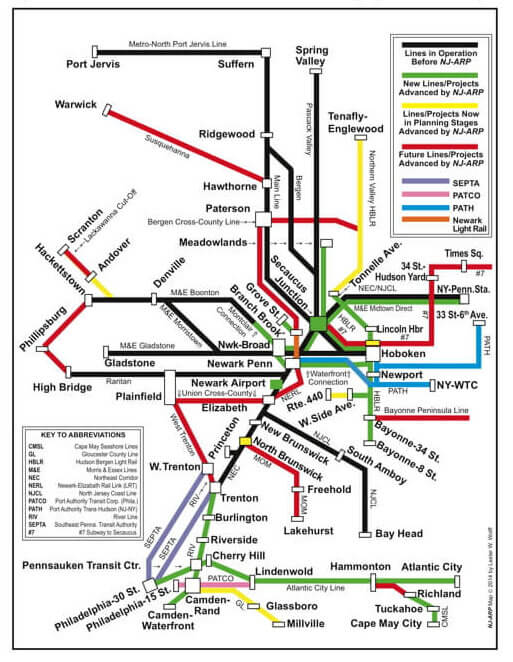
No. 7 Subway to Secaucus Junction Report Released: A conceptual planning report describing a potential extension of MTA New York City Transit’s No. 7 subway line to Secaucus Junction was released by the City of New York’s Economic Development Corporation on April 9th. The City commissioned the report, prepared by Parsons Brinckerhoff (PB), after Mayor Michael Bloomberg proposed the idea in the aftermath of New Jersey Governor Chris Christi’s decision to cancel New Jersey Transit’s Access to the Region’s Core (ARC) Project in October 2010.
The PB report proposes that the No. 7 subway line be extended from south of the 34th Street and 11th Avenue Station, now in an advanced state of construction, under the Hudson River generally following the alignment of the aborted ARC tunnels to North Bergen, New Jersey, where the rapid transit line would surface and continue westward on aerial structure east of Amtrak’s ex-Pennsylvania Railroad “High Line” to Secaucus Junction, where a railroad-subway-bus terminal interchange station would be built. A storage yard for subway trains would be built beyond Secaucus Junction in an area currently occupied by landfill. The conceptual alignment for the No. 7 Line also makes provisions for two additional railroad tracks required for Amtrak’s Gateway Project, as well as expansion of the existing Secaucus Junction station building.
The proposal envisions that No. 7 trains would operate every two minutes (30 trains per hour) between Secaucus Junction and Main Street, Flushing during peak periods, taking 16 minutes to reach Grand Central Terminal on Midtown Manhattan’s East Side. Other destinations that could be reached from Secaucus Junction on No. 7 trains include the Jacob Javits Convention Center, Times Square, and Citi Field, the home of the New York Mets baseball team.
The Star Ledger (which scooped The New York Times on this story) quoted Mayor Bloomberg as saying “It’s been a century since there was a new rail tunnel under the Hudson, and demand for travel between New Jersey and Manhattan is growing rapidly and quickly exceeding the capacity of existing transit infrastructure. The lack of new transit investment is a serious and urgent threat to New York City’s economic competitiveness. Extending the 7 train to Secaucus is a promising potential solution – it would leverage existing investments and be compatible with other proposed projects – and is deserving of serious consideration.”
In contrast with Mayor Bloomberg’s visionary approach, which recognizes regional needs, the MTA wasted no time in pouring cold water on the idea. Even though the PB report does not include a detailed estimate of the costs involved in building and operating an extension of its No. 7 subway line to Secaucus Junction, MTA Spokesman Kevin Ortiz said “We don’t see this as an economically viable option.” This echoed a policy position taken last year by the MTA’s former Chairman and Chief Executive Officer, Joseph J. Lhota, who responded “It’s not going to happen in our lifetime – it’s not going to happen in anybody’s lifetime.” The Daily News reported, however, that earlier in the day the New York State agency had promised to study the “interesting” idea. The MTA’s more parochial view reflects its concern that there will not be enough money available proceed with many of the public transportation system expansion projects already planned, such as extension of the long-awaited Second Avenue Subway (finally under construction between 63rd and 96th Streets in Manhattan’s Upper East Side) north to 125th Street and Lexington Avenue and eventually into The Bronx, as well as in stages south to 42nd Street, 14th Street and Water Street in Lower Manhattan.
The MTA’s next five-year capital investment program for system renewal and expansion projects is not funded at this time. Its current program involves $22 billion in expenditures and ends in 2014. This program is viewed by informed observers as likely to be subject to cost overruns relating to both the first phase of the Second Avenue Subway (currently scheduled for completion in 2016) and the East Side Access Project to extension of the Long Island Rail Road to a deep-level station under Grand Central Terminal (now delayed to a 2019 opening). The City of New York – not the MTA – is funding the currently under construction extension of the No. 7 Line from Times Square to 34th Street and 11th Avenue, expected to open in 2014. Its main purpose is to enhance the commercial viability of the Hudson Yards development project, a high priority of the Bloomberg Administration.
Meanwhile, a spokesman for New Jersey’s Governor Chris Christie said that he was “intrigued” when extension of the No. 7 subway line to Secaucus was first proposed by Mayor Bloomberg and would continue to explore its viability, as well as that of Amtrak’s Gateway Plan. The Star Ledger also asked Jack May,
NJ-ARP’s Vice President for comments. The newspaper reported that Jack said our organization favors extending the No. 7 subway line to Secaucus but said that this proposal is not the only solution for improved transit in New Jersey. Jack was quoted saying “This will allow passengers from Bergen County to have a two-seat ride to the East Side of New York. They now have to deal with a real mess at the Port Authority Bus Terminal to make a transfer. This would be a very user-friendly situation. This will also relieve a lot of crowding on trains that go to Penn Station. Many of the people coming up the Northeast Corridor and Midtown Direct [trains] will transfer to the No. 7 to get to the East Side, which will leave seats for those people who want to come from Bergen County to get to Penn Station. So this is a win-win situation.” Jack also stated that the No. 7 Line extension would complement Amtrak’s Gateway Plan, with its additional tunnels and improvements at Penn Station allowing for a large increase of trains between New Jersey and New York to meet the demand for more service from the Northeast Corridor, Midtown Direct and other connecting lines operated by New Jersey Transit.
NJ-ARP has also issued an April 11 Press Release detailing its support of the 7 to Secaucus and showing how the project would be beneficial not only to all NJ Transit rail passengers, but also to all bus passengers who are currently using the already at-capacity Lincoln Tunnel express bus lane (XBL), and even more so to those who make the slog from the P.A. Bus Terminal to the Times Square subway station complex for connections to the East side of Manhattan.
Thomas Prendergast to Head the MTA:
New York State’s Governor Andrew Cuomo has nominated Thomas F. Prendergast to become Chairman and Chief Executive of the New York State Metropolitan Transportation Authority (MTA) on April 12th. The Governor’s choice to head the MTA is subject to confirmation by the New York State Senate, although that is likely to be pro forma. Mr. Prendergast has been serving as Interim Executive Director of the MTA following the resignation of Joseph J. Lhota, the previous Chairman and CEO, who plans to run for Mayor of New York City on the Republican Party ticket. Mr. Prendergast has been the President of MTA New York City Transit since 2009. He and his team garnered considerable praise for protective steps taken in advance of Superstorm Sandy, enabling the subway and bus system to avoid severe damage to almost all of its rolling stock. Much of its quick recovery, notwithstanding significant flooding experienced in Lower Manhattan and in subway tunnels under the East River, had to do with developing a plan to move trains and buses out of the path of potential floodwaters and to secure sensitive electronic equipment – a plan that took into account experience in August 2011 during Hurricane Irene.
Mr. Prendergast, a native of Illinois, began his career in the public transportation field with the Chicago Transit Authority (CTA) in 1975 as a Planning Analyst. After working in Washington, DC for the Federal Transit Administration (FTA) as a Transit Safety Systems Specialist, he joined the New York City Transit Authority (NYCTA) in 1982 as its Director of System Safety, Subways; subsequently becoming Assistant Vice President, Office of System Safety for the entire transit system. In 1990, Mr. Prendergast was appointed Senior Vice President, Subways of MTA New York City Transit (MTA NYCT as NYCTA become known to emphasize its relationship to the MTA), a position he held for the next four years. Between 1994 and 2000, Mr. Prendergast was the President of the Long Island Rail Road, after which he joined Parsons Brinckerhoff (PB) as the President of its Transit and Rail Systems subsidiary and later became its Director of Services for the Americas.
Mr. Prendergast left PB in July 2008 to become Chief Executive Officer of the South Coast British Columbia Transportation Authority, known locally as TransLink, the agency responsible for the of the Vancouver area’s SkyTrain automated light rapid transit lines, its diesel buses and electric trolley buses, the SeaBus ferries crossing Burrard Inlet, West Coast Express commuter trains serving the Fraser River Valley, and major roads and bridges; he held this position for approximately 15 months, resigning in November 2009 to return to MTA NYCT as its President.
Prior to announcement of Governor Cuomo’s selection of Mr. Prendergast to head the MTA, Mitchell Moss, the Director of the Rudin Center for Transportation Policy at New York University lauded him with these remarks: “What everyone has come to realize is that Tom has certainly risen to the occasion. He knows what the priorities are. He doesn’t have to be briefed to understand what needs to be done.” That accolade cannot be said about most of his predecessors.
Metro-North Railroad Completes Major Service Expansion:
MTA Metro-North Railroad (MNR) completed its largest and most ambitious service expansion on Sunday, April 7th by adding 187 trains per week to the schedules of its Hudson, Harlem and New Haven Lines. This was in addition to 56 trains per week added last October. By adding off-peak and weekend trains, as well as additional stops at key stations, has increased the frequency of the services offered to its passengers. The new timetables provide 85 additional weekday trains and 22 additional weekend trains on the Hudson Line; 65 additional weekday trains and 6 additional weekend trains on the Harlem Line; and 9 additional weekend trains on the New Haven Line.
Improvements in the new Hudson Line timetable include:
Improvements in the new Harlem Line timetable include:
Improvements to the newest New Haven Line timetable include:
Metro-North Railroad is the most heavily patronized suburban railroad in the United States, having overtaken the Long Island Rail Road – the long-term holder of that title - in 2011. MNR carried 83.5 million passengers in 2012 compared to the LIRR’s 81.7 million passengers. Both railroads would have had even higher ridership levels in 2012 were it not for Superstorm Sandy.
MNR’s President, Howard Permut, observed “Our ridership has doubled in the 30 years since Metro-North’s inception and was on track to be the highest ever in 2012 before Sandy struck. Nevertheless, by providing consistent and reliable service and good value, we have been able to double ridership from about 40 million a year to more than 83 million now and we expect that trend to continue.”
In the opinion of many observers, Metro-North also is the best-run suburban railroad in the United States. Much of MNR’s success in increase ridership is the result of its pursuing markets that are not a traditional focus for a “commuter railroad,” including passengers whose journey-to-and-from-work needs are opposite the predominate weekday AM and PM peak period commuters, as well as discretionary weekday off-peak and weekend riders. MNR recognizes that when a person with a practical choice fills an otherwise empty seat on one of its trains, the result is “found revenue” that reduces its operating deficit. MNR also sees the value of offering its passengers zoned express and local services (a practice begun by the New York Central Railroad more than a half-century ago), as well as clockface even-interval train schedules during weekday off-peak periods and on weekends. The public’s response is reflected in the ever-growing number of riders that board Metro-North trains.
Pearls of Wisdom from the Editor-in-Chief of Railway Age: William C. Vantuono, the Editor-in-Chief of Railway Age, wrote these words in response to the clamor from ultra-conservatives who seek, by one means or another, to shut down Amtrak, reprinted here with permission:
“If the source of funding isn’t fares, then Amtrak needs to go away”
It’s 12:00 a.m. on Monday, April 8 as I write this. I’m tired, and I want to go to bed. I have to get up tomorrow morning, and go into the office. For some reason that I do not completely understand, I take a quick look at my e-mail inbox on my iPhone before placing it into the neat little iHome device that serves as a musical alarm clock. (Apologies for the advertisement.)
Oh, look: I have one e-mail. Let me see what it is. Well, it’s another comment on Frank Wilner’s excellent blog on Amtrak haters that needs my yay or nay. Here’s what it says: “If the source of funding isn’t fares, then Amtrak needs to go away.”
Oh, give me a break. I think I’ll deep-six this one. (I’m the editor-in-chief. I can do that.) So I do. But, wait a minute. That comment is ridiculous, so off-the-wall, and so typical of people who are totally clueless about public transportation, that I think I should respond with a blog, and maybe have a little fun while doing it. I think I’ll stay up for a while. This is too tempting to resist! Okay. Here goes. Let’s try some analogies. For clarification purposes, let’s assume that “the source of funding” means “100% of the source of funding.”
Do you see where I am headed?
Let’s take this a little further. This is fun!
Now, I know that the following examples are rather ridiculous, but what the heck:
I could go on and on and on and on: Those last few examples were pretty silly right? Well, no sillier than “If the source of funding isn’t fares, then Amtrak needs to go away.” By the way, it wasn’t Congressman John Mica who submitted that comment on Frank Wilner’s blog. Do you think he might have used a pseudonym? I close this early morning commentary with a very astute observation from Railway Age’s esteemed Senior Consulting Editor, Luther S. Miller:
“The United States of America is not a business. It is a society.”
To with we at NJ-ARP can only exclaim HEAR! HEAR!
Coming Events
The Next NJ-ARP Board Meeting is on May 18, 2013: The next meeting of the NJ-ARP Board of Directors has been scheduled for Saturday, May 18, 2013. It will be held in the Chatham, N.J. Library commencing at 9:30 AM. Please see our Calendar of Events for updated information. All currently-paid up members are welcome to attend and participate in the Board’s discussions. Those wishing to attend meetings are requested to please e-mail NJ-ARP at njarp@nj-arp.org at least three (3) weekdays prior to the meeting, leaving your name and phone number so that we can notify the venue how many members will be attending, as well as contact you with any late venue or time changes.