

Current News
NJ Transit Moves Ahead with Light Rail to Englewood Hospital:
New Jersey Transit’s Board of Directors, at its meeting held on Wednesday, May 8th, approved a $3,000,000 (plus five percent for contingencies) amendment to an existing contract with the Jacobs Engineering Group, Inc. (formerly Edwards and Kelcey, Inc.) for assistance during preparation of the Final Environmental Impact Statement (FEIS) for the Northern Branch Corridor Project. This is not “another study,” notwithstanding a misleading headline that appeared in a major regional newspaper, but an effort to satisfy the requirements of the National Environmental Policy Act (NEPA) of 1966, without which any project involving federal financial assistance and/or federal approvals cannot take place.
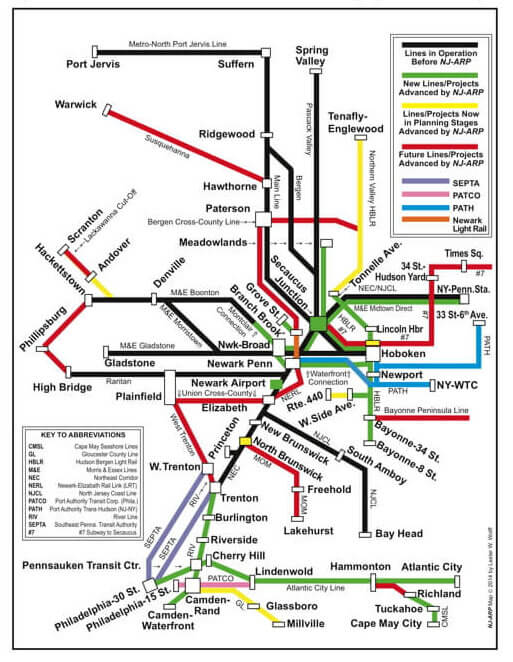
The Northern Branch Corridor Project involves extending the Hudson-Bergen Light Rail (HBLR) system from its current northern terminal at Tonnelle Avenue, North Bergen along the former Erie Railroad’s Northern Branch (now owned by CSX Transportation) into Bergen County for the first time. The resolution passed unanimously by NJT’s Board specifies that the FEIS will be based on a “modified alternative terminating at Englewood Hospital.”
The Draft Environmental Impact Statement (DEIS) for the project, which was the subject of public hearings held on January 24, 2012 in Tenafly and January 26, 2012 in Englewood, considered two alternatives: 1) Extending HBLR to Route 4 in Englewood, just north of the Leonia/Englewood boundary, where a 670-space park-and-ride lot would be provided; and 2) Continuing through downtown Englewood, past Englewood Hospital and through downtown Tenafly to Tenafly North, a short distance south of the Tenafly/Cresskill boundary, where a 570-space park-and-ride lot would have been provided.
While Ridgefield, Palisades Park, Leonia and Englewood supported extension of HBLR to serve their communities, Tenafly’s municipal government strongly opposed it claiming the that project would cause irreparable damage to its borough. In particular, Mayor Peter S. Rustin – who years before the public hearings were held had proposed that the Tenafly Town Center Station be deleted because stopping trains there would “destroy” the business district – orchestrated hysterical opposition to the project by local NIMBYs, to the extent of holding a “No Trains Here” rally at the historic Tenafly railroad station. This beautiful Queen Anne-style structure was constructed in 1872 by the Northern Railroad of New Jersey, which was absorbed by the Erie Railroad in 1942 long after becoming its subsidiary.
The history of what became the Northern Branch Corridor Project and the current decision to prepare an FEIS for an extension the Hudson-Bergen Light Rail system to Englewood Hospital can only be described as tortuous, including a years-wasting technological flip-flop from electric light rail to diesel multiple unit (DMU) cars and then back to electric light rail. The Agenda Item before NJ Transit’s Board listed the following steps preceding the recommendation action:
What will follow this approval? As Mr. Weinstein explained in response to a question asked at the May 8th Board Meeting by NJ-ARP Vice President, NJ Transit expects that it will take another two years to complete the Northern Branch FEIS, i.e. until mid-2015. Given past performance of the participants, NJ-ARP anticipates that another year will be required for FTA to approve the FEIS and grant the Record of Decision (ROD) that would make the project eligible for federal financial assistance; that would extend the federal approval process to mid-2016. Only then and providing that state and/or local matching funds become available, would the project become in line for a federal grant allowing final engineering to proceed; optimistically, that could another year and one-half – to early 2018 - to the earliest likely date for the start of a three-to-four year long construction phase. Unless a serious effort is made to speed up the process, the inauguration of direct light rail transit service between the Hudson River Waterfront and Englewood Hospital will not occur before 2021-2022, more than a quarter century since the Northern Branch was identified as a candidate for extending HBLR into Bergen County.
Changing this slow-moving scenario requires active involvement from key members of New Jersey’s Congressional Delegation, Members of the State Legislature, Bergen County’s Freeholders and Executive, and elected officials of the four municipalities along the Northern Branch – Ridgefield, Palisades Park, Leonia and Englewood – that have supported the long-awaited extension of HBLR. Where NJ-ARP is concerned, our voice will continue to be heard making suggestions concerning what is need to move this project ahead in a more timely manner. We are mindful that, when the political stars were aligned, the initial segment of the Hudson-Bergen Light Rail system, extending from 34th Street, Bayonne to Exchange Place, Jersey City with a branch to West Side Avenue, Jersey City, was built and commissioned within 40 months between the issuance in November 1996 of Notice-to-Proceed to 21st Century Rail Corporation (the Design-Build-Operate-Maintain or DBOM contactor) and the commencement of revenue service in April 2000.
NJ Transit Rail Fleet Status Report:
As was committed by James Weinstein, NJ Transit’s Executive Director, at the New Jersey Transit Board Meeting held on Wednesday, April 9, 2013, this information is being updated every two weeks. The information presented below is as of May 8, 2013. The Superstorm Sandy Recovery Progress Card is posted on the state transportation agency’s website under the heading Repair, Recovery and Resiliency Projects, which in addition to that relating to rolling stock, contains considerable additional information relating to infrastructure.
Compared to the information made public on April 9th, NJ Transit added three recently delivered multilevel coaches to its passenger car fleet and returned six multilevel coaches, two Jersey Arrow III multiple-unit electric cars, and fourteen single level coach to service as of May 23rd; the status of 24 out-of-service locomotives, including nine ALP-45DP dual powered locomotives, remains the same as it was six weeks ago.
All 35 of the ALP-45DP locomotives ordered from Bombardier by New Jersey Transit had been delivered when Superstorm Sandy struck on October 29, 2012. The discrepancy between a total fleet of 23 and 35 locomotives delivered lies in the fact that 12 dual powered locomotives (understood to be 4522 through 4533) had not completed testing prior to acceptance by NJ Transit, were at the MMC when they were damaged flood waters, and therefore are the responsibility of Bombardier to repair at its expense or that of its insurers rather than NJ Transit.
Summit Interlocking to be Moved to the West:
New Jersey Transit’s Board also approved the award of a $1,999,944.71 (plus five percent for contingencies) contract with the Jacobs Engineering Group, Inc. for design services for the planned relocation of the interlocking plant of the Summit Station of its Morris & Essex Line on May 8th. The current arrangement requires trains reversing direction to occupy a main line track at the station. The planned new interlocking, consisting of switches, crossovers and associated signaling equipment, will be located approximately one mile to the west of the station. It will contain a pocket track that will allow trains of up to 12 cars, compared to six cars under the present arrangement, to reverse direction while allowing all three tracks at the Summit Station to be used for through service. NJ Transit expects that the new layout will be in place in 2017.
Perth Amboy Station to be Made ADA Compliant:
New Jersey Transit’s Board, also acting on May 8th, approved a $2,051,128 (plus five percent for contingencies) contract with Stantec Consulting Services to provide final design and engineering services for the Perth Amboy Station Accessibility Improvements Project. Currently, the Perth Amboy Station has two side platforms located in a cut below street level. Access to these platforms from the station building, is provided only by steps, leaving this station as one of the few remaining on the North Jersey Coast Line between Woodbridge and Long Branch (the southern limit of electrification) that is not accessible to passengers with disabilities and other mobility limitations. The project will reconfigure the station with a centrally located island platform with access between street-level and platform-level provide by an elevator, as well as stairways. Along with canopies and platform-level waiting areas, the new facilities will be complaint with the Americans with Disabilities Act (ADA).
MARC to Add Weekend Trains between Baltimore and Washington:
Following Governor Martin O’Malley’s signature of legislation that increased Maryland’s gasoline tax from 13 cents to 20 cents per gallon, the Maryland Department of Transportation (MDOT) announced on May 16th that it is negotiating with Amtrak for “slots” that will enable it to add eight round trips on Saturdays, Sundays and Holidays between Baltimore and Washington to the Penn Line of the Maryland Area Regional Commuter (MARC) service. Since its inception in 1983, MARC trains have operated only on weekdays. MDOT hopes to implement the expanded service before the end of 2013. In addition, as part of $1.2 billion in new highway and transit projects to be funded by the gasoline tax, $170 million will be devoted to final design of Baltimore’s Red Line (a 14-mile east-west light rail connecting Woodlawn, Downtown Baltimore and Bayview) and $280 million for the Purple Line (a 16-mile light rail line in the Washington suburbs extending from Bethesda through Silver Spring to New Carrollton).
North County Transit District Resumes Sprinter Service:
The diesel multiple unit (DMU) service run by the North County Transit District (NCTD) between Oceanside and Escondido, California, known as the Sprinter, resumed operation on Saturday, May 18th. The DMU operation was suspended abruptly on Friday, March 8th after an inspector of the California Public Utilities Commission (CPUC) observed an accelerated wear pattern on the brake rotors (disks) on all twelve of NCTD’s Siemens-built Desiro DMUs used on the Sprinter, which are not compliant with FRA regulations governing passenger equipment used in mixed service with railroad freight trains. In addition to installing new split-disk rotors on the DMUs, during the two-month shutdown of the rail passenger service, NCTD and its contractors performed routine maintenance work on the DMUs, which included engine checks, air conditioning system maintenance, extensive interior cleaning, replacement of worn seat fabric, graffiti removal and exterior waxing of the two-section articulated vehicles to give them a like-new appearance when service was resumed. [A more extensive discussion of the causes of the two-month plus service suspension can be found in the April 1, 2013 edition of The Hot Wire, which remains available on the Members’ Area.]
San Diego’s Mid-Coast Corridor Transit Project Moves Forward:
The San Diego Association of Governments (SANDAG), after receiving approval from the Federal Transit Administration (FTA), has released the Draft Supplemental Environmental Impact Statement and Subsequent Environment Impact Report (SEIS/SEIR) of the Mid-Coast Corridor Transit Project for public review and comment. The proposed project involves extending the San Diego Trolley system for 10.9 miles from the Old Town Transit Center (OTTC) to University Towne Centre (UTC) Transit Center in the University City area of California’s second largest city.
SANDAG will hold four open houses during June followed by a public hearing on Friday, June 21st to provide the public with opportunities to learn about the project and offer comments on the Draft SEIS/SEIR. The conclusion of this process is expected to result in a Final Environmental Impact Statement (FEIS) and Record of Decision (ROD), followed by conclusion of a Full Funding Grant Agreement (FFGA) between SANDAG and FTA. The total estimated capital cost of the project is $1.985 billion in year-of-expenditure dollars, with the proposed New Starts Program funding anticipated to be $980 million or 49.4 percent of the total capital investment. TransNet, the San Diego County half-cent sales tax dedicated to local transportation projects, will provide the local matching funds required as part of the FFGA.
Inasmuch as SANDAG applied for entry into the FTA’s New Starts Program on May 13, 2011 and FTA granted permission for the project’s entry into the Preliminary Engineering phase of the New Starts Program on September 2, 2011, it is anticipated that construction will begin in 2015 and that the trolley extension will be in revenue service in 2018
The Mid-Coast Corridor Transit Project, when implemented, will re-extend the STD’s Blue Line (which currently operates between America Plaza, adjacent to the Santa Fe Depot In Downtown San Diego, and San Ysidro at the USA/Mexico border), north along existing tracks shared with the Green Line, for approximately 3.5 miles through the Old Town Transit Center (where it terminated prior to September 2, 2012) to a new junction immediately south of the San Diego River, where the Green Line turns east to run through the Mission Valley to Santee.
Beyond the San Diego River junction, the Blue Line will continue on the east side of the former Atchison, Topeka and Santa Fe Railway’s Los Angeles-San Diego main line, now owned by he North County Transit District (NCTD) and operated over by Amtrak’s Pacific Surfliner long-distance trains, NCTD’s Coaster regional rail service connecting Oceanside with San Diego, and Burlington Northern Santa Fe Railway (BNSF) freight trains. After crossing above Balboa Avenue, the double-tracked Blue Line will enter the narrow Rose Canyon, currently the province of Interstate Highway Five (I-5) which connects America’s Canadian and Mexican borders, the single-tracked railroad line, and little else of note.
As the Blue Line continues northward, its double-tracked alignment will pass under the railroad as the latter begins a circuitous hairpin alignment laid out the 19th century for steam locomotive-hauled trains that takes it east, north and west of University City before continuing north to Del Mar. The trolley line will then cross over I-5 on an overpass to serve the West Campus of the University of California San Diego (UCSD), located in the eastern part of affluent La Jolla, cross over I-5 a second time to serve UCSD’s East Campus, and then continue on aerial structure above Genesee Avenue through University City to its new terminus at the UTC Transit Center.
The project will include eight new stations (three at grade and five elevated), five park-and-ride facilities with 1,070 parking spaces, fourteen new and four upgraded traction power substations, and the purchase of 36 additional low-floor light rail vehicles. The three at-grade stations will be Tecolote Road, Clairmont Drive and Balboa Avenue, all located south of the Rose Canyon between the railroad and Morena Boulevard; there will be an option for an additional at-grade station at the Veterans Administration Medical Center in eastern La Jolla. The Noble Drive, UCSD West, UCSD East, Executive Drive, and UTC Transit Center stations will be on aerial structures.
When this project is completed, the Blue Line will run for almost 30 miles from the San Ysidro Transit Center at the international border to University City via C Street through Downtown San Diego. The Blue Line currently carries approximately 42,100 passengers on weekdays but during a depressed economy. Its extension to University City is forecast to increase weekday ridership on the Blue Line by 36,400, suggesting that overall Blue Line ridership is likely to substantially exceed 78,500 passengers. There would be 45,100 riders on weekdays between the Santa Fe Depot and the UTC Transit Center, of which 32,400 would travel north of the Old Town Transit Center. In order to accommodate this passenger volume, SDT anticipates running Blue Line trains of up to four cars long every 7.5 minutes between approximately 6:00 AM and 6:00 PM on weekdays and every 15-to-30 minutes at other times, including weekends and holidays. In addition, Green Line trains will continue to operated every 15 minutes (30 minutes during late evenings) between the 12th and Imperial Transit Center and the Old Town Transit Center, routed by way of the Bayshore Line to the Santa Fe Depot, and then continue east through the Mission Valley to San Diego State University (SDSU), El Cajon and the Santee Town Center.
With a look towards the long-range future, San Diego Mayor Robert Earl “Bob” Filner, a former Member of the US House of Representatives, endorsed the idea of extending the Trolley to San Diego International Airport on January 19, 2013. One scenario under consideration would involve extending the Orange Line (which currently runs between El Cajon and the Santa Fe Depot) along Harbor Drive to the south side of Lindbergh Field, where the airport’s three terminals are located. The Orange Line, which east of 12th and Imperial follows what was once the Lakeside Line of the former San Diego and Arizona Eastern Railway, currently has an operationally awkward reversing arrangement at the Santa Fe Depot, involving bi-directional operation on the outbound track between a crossover east of America Plaza and the inbound track at the Santa Fe Depot. This must change in the future.
Even with double-track uni-directional operation through America Plaza after the Blue Line is extended to University City, is seems doubtful that it will be practical for the Orange Line to reverse direction at the Santa Fe Depot every fifteen minutes with eight Blue Line and four Green Line trains also passing through the station in each direction every hour; something will have to give in order to ensure operational reliability of the Trolley system as a whole. That alone may make constructing a branch to the airport (and perhaps beyond) attractive as SANDAG’s planners develop the alternatives.
Coming Events
Next NJ-ARP Board Meeting in Belmar on July 13, 2013: The next meeting of the NJ-ARP Board of Directors has been scheduled for Saturday, July 13, 2013. We are considering making this a luncheon meeting (at cost to attendees) rather than the usual breakfast meeting. It will be held in Belmar, New Jersey at a venue yet to be determined. Belmar was chosen because only during the summer season does New Jersey Transit operate an hourly headway on the non-electrified Long Branch to Bayhead portion of the North Jersey Coast Line. This will enable members who wish to travel by train to the meeting with schedule flexibility not present during the remaining “off-season” months of the year. Please see our Calendar of Events for updated information. All currently-paid up members are welcome to attend and participate in the Board’s discussions. Those wishing to attend meetings are requested to please e-mail NJ-ARP at njarp@nj-arp.org at least three (3) weekdays prior to the meeting, leaving your name and phone number so that we can notify the venue how many members will be attending, as well as contact you with any late venue or time changes.